Arunachal Scholar Dr Prem Taba Awarded SAARC Grant for Tribal Heritage Research
The APU academic will examine how major museums in Arunachal Pradesh and Bhutan represent indigenous communities and communicate the shared tribal heritage of the Eastern Himalayan region.
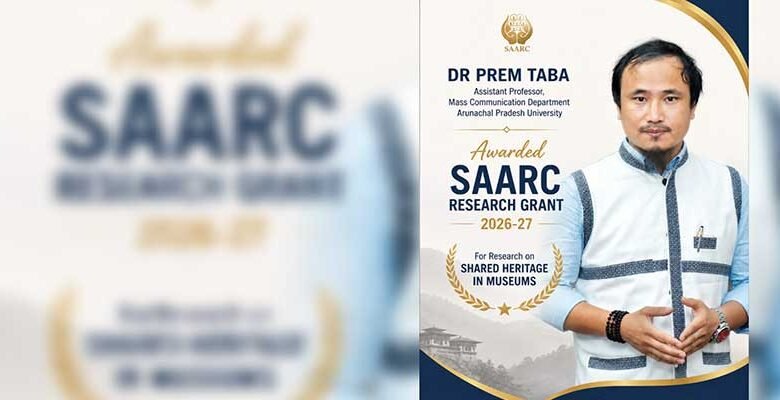
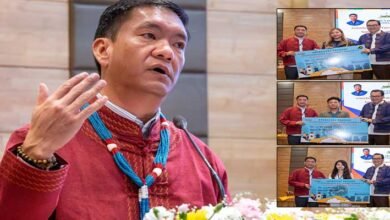
PASIGHAT- Arunachal Pradesh University’s (APU) Mass Communication Department Assistant Professor Dr Prem Taba has been awarded the prestigious South Asian Association for Regional Cooperation (SAARC) Research Grant (SRG) 2026-27 by the SAARC Cultural Centre (SCC), Colombo.
The grant has been awarded for a research project under the theme, “Interpreting Shared Heritage: Cross-Cultural Narratives in Museums in the SAARC Region.”

The selection was communicated through an official Letter of Offer dated July 8, 2026, signed by Dr Kaushalya Kumarasinghe, Director of the SAARC Cultural Centre.
According to the letter, the selection followed a “highly competitive” review process. It stated that Dr Taba’s proposal demonstrated “considerable scholarly merit and relevance to the theme of the SRG.”
Dr Taba’s winning research proposal is titled “When the Vitrine Silences the Forest: Decolonising Tribal Heritage Communication in the Museums of the Eastern Himalayan SAARC Corridor.”
The study will examine how two major cultural institutions — the Jawaharlal Nehru State Museum in Itanagar and the National Museum of Bhutan in Paro — represent, interpret and communicate the heritage of the region’s tribal communities.
The research is expected to focus on the relationship between museum displays and the lived cultural realities of indigenous communities. It will examine not only what is presented inside museum spaces but also which voices, knowledge systems and cultural perspectives may remain underrepresented.
The project places Arunachal Pradesh and Bhutan within a wider Eastern Himalayan cultural corridor, where communities have historically shared cultural practices, ecological knowledge and traditions across modern national boundaries.
Each awardee under the SAARC Research Grant programme receives US $3,000. The amount is disbursed in two instalments, with US $1,500 provided at the commencement of the project and the remaining US $1,500 released after the submission and acceptance of the final research report.
Also Read- AAPSU Gives Govt Seven Days to Respond on Recruitment, Indigenous Rights and More
Reacting to the recognition, Dr Taba said the award was a moment of pride not only for him but also for the wider academic and cultural community of the region.
“This grant is a recognition that the heritage of our tribal communities belongs not only to Arunachal Pradesh, but to the shared cultural memory of South Asia,” he said.
Dr Taba said the research was also personally significant as it would provide an opportunity to bring the voices of local communities into a broader discussion on the way museums represent indigenous knowledge.
“For me, this is deeply personal: it is an opportunity to bring the voices of our own people into a global conversation on how museums represent, or fail to represent, indigenous knowledge,” he said.
He added that the recognition offered an opportunity for Arunachal Pradesh University and the state to gain greater visibility on an international academic and cultural platform.
“I see this as a moment for Arunachal Pradesh University and for our state to be seen and heard on a platform like SAARC, and I hope this work opens the door for more scholars from our region to engage with international academic and cultural institutions,” Dr Taba said.
The SAARC Research Grants 2026 were approved by the Fifteenth Meeting of the Governing Board of the SAARC Cultural Centre, held in Colombo in August 2025. The programme was subsequently endorsed at the Sixty-second Session of the SAARC Programming Committee Meeting in Kathmandu in February 2026.
The programme invited academics and researchers from SAARC member states — Afghanistan, Bangladesh, Bhutan, India, Maldives, Nepal, Pakistan and Sri Lanka — to submit original research proposals.
The 2026 grant theme focuses on how museums across South Asia interpret and communicate cross-cultural heritage narratives. The selection of Dr Taba’s proposal brings attention to the question of how tribal and indigenous heritage is represented within formal cultural institutions in the Eastern Himalayan region.
The research also has wider relevance to ongoing academic discussions on decolonising museums. Such discussions examine whether conventional museum practices adequately reflect the perspectives, knowledge systems and living experiences of the communities whose cultural objects and traditions are displayed.
By studying museums in both Arunachal Pradesh and Bhutan, the project is expected to offer a cross-border perspective on the communication of indigenous heritage in a region with deep cultural and historical connections.
Under the terms of the grant, Dr Taba will be required to submit a final publishable research report. The report must incorporate recommendations made by the SCC’s Research Grants Committee or Research Review Committee.
The completed research will be subject to review and editing and may subsequently be published under the SAARC Cultural Centre’s publications programme.
Dr Taba’s selection places an academic from Arunachal Pradesh within a regional research initiative involving scholars from across South Asia and highlights the growing relevance of indigenous heritage, museum representation and cross-cultural communication in contemporary academic research.