APU Induction Programme Highlights Journalism, Entrepreneurship and Regional Storytelling
At its orientation-cum-induction programme, APU’s Mass Communication Department urged students to bring greater accuracy and depth to stories from Arunachal Pradesh and the Northeast, while introducing them to journalism, digital media and creative entrepreneurship.
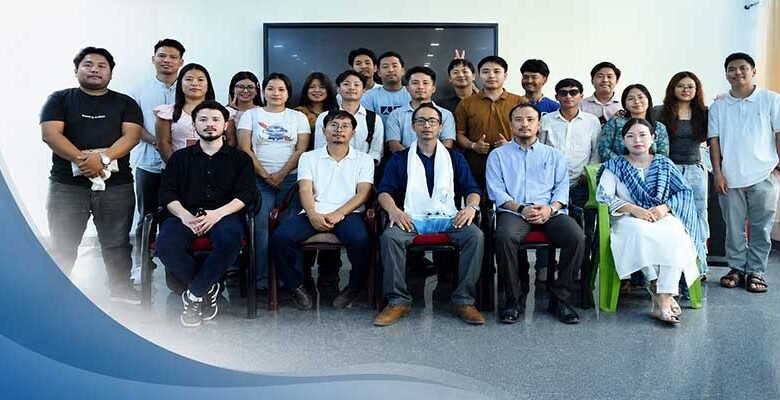
PASIGHAT- The Department of Mass Communication at Arunachal Pradesh University ( APU ) welcomed its second batch of students with an Orientation-cum-Induction Programme on Sunday, with the department’s Head, Dr Prem Taba, urging the newcomers to use journalism to bring greater visibility and depth to stories from Arunachal Pradesh and the Northeast.
The programme, held at the Seminar Hall of the Academic Block, marked the beginning of the academic journey for the department’s first-semester students. The department was established in August 2025, making the latest intake its second batch.

Addressing the students, Dr Taba said journalism rests on three core principles—truth, voice and accountability. He urged the students to remain curious, honest, disciplined and respectful as they prepare for careers in the media.
Also Read- Dasanglu Pul Reviews Development Schemes in Anjaw, Calls for Time-Bound Action
He particularly called upon them to tell the stories of Arunachal Pradesh and the wider Northeast, which he described as a region that remains underrepresented in national media. According to him, students from the region can bring a level of accuracy, context and depth to these stories that comes from being familiar with the communities and issues they cover.
Dr Taba also introduced the students to the history and vision of Arunachal Pradesh University, established in 2022 as the state’s first and only state university. He said the university was established with the objective of providing quality higher education to the youth of Arunachal Pradesh without requiring them to leave the state.
The university currently has 11 operational departments and follows the motto “Knowledge is Supreme Power.” Dr Taba outlined its vision of becoming a leading institution of excellence in knowledge, culture and human development through education and research contributing to the socio-economic development of the state.
Also Read- Arunachal flash flood: Five Army Personnel Missing, Four Killed in Separate Disasters
He also explained the structure of the department’s two-year M.A. programme in Mass Communication, which offers an exit option of a postgraduate diploma after the first year under the National Education Policy (NEP) 2020.
The programme combines communication theory, media history, law and ethics with practical training in print, broadcast and digital media, with development communication forming an important focus.
The orientation also exposed students to opportunities beyond conventional journalism.
Ashish Gupta, a Pasighat-based photographer and owner of Studio 911, was the expert speaker at the programme. Drawing from his experience of building a full-scale photography studio from modest beginnings, Gupta told students that while a photograph may be the final product, professionalism forms the foundation of the business.
Also Read- Mahabodhi Lord Buddha College Gets New Library, Conference Hall and Girl’s Home
He encouraged students to actively engage with the creative process rather than wait for ideal opportunities, while emphasising the importance of learning from mistakes and developing strong technical skills. His presentation also highlighted entrepreneurial possibilities in photography, advertising and filmmaking.
The programme included several experiential learning activities. It began with an ice-breaker session, “The Question Jar,” where students discussed campus life, career aspirations and aspects of their cultural heritage. Discussions touched upon subjects including Apatani Pikey Pila cuisine, integrated fish culture and traditional Tiipe facial tattooing.
A short film titled ‘Paradox’, produced and directed by third-semester students, was also screened. A discussion with its director and writer, Meena Taku, followed the screening.
Guest faculty Doli Ete conducted a communication game designed to demonstrate the concept of message dilution, giving students an opportunity to understand communication concepts through participation rather than classroom theory alone.
Earlier, guest faculty Mitinam Siram welcomed the gathering and encouraged the new students to maintain academic discipline and participate actively in departmental activities.
The programme concluded with a vote of thanks by Assistant Professor Dr Kombong Darang, who acknowledged the support of the university administration and thanked those present.
Dr Darang also reminded the students that regular attendance and active participation inside and outside the classroom are essential components of professional development.
The orientation, therefore, went beyond a formal welcome for the new batch. By combining journalism ethics, regional storytelling, practical media exposure and creative entrepreneurship, the programme introduced students to the department’s broader approach to preparing media professionals who can work across traditional and emerging platforms while remaining connected to the realities of Arunachal Pradesh and the Northeast.