Arunachal Launches Major Deregulation Drive Across 51 Reform Areas to Attract Investment
The state government says reforms spanning land, labour, environment, education and industrial approvals are aimed at reducing compliance burdens and improving the ease of doing business.
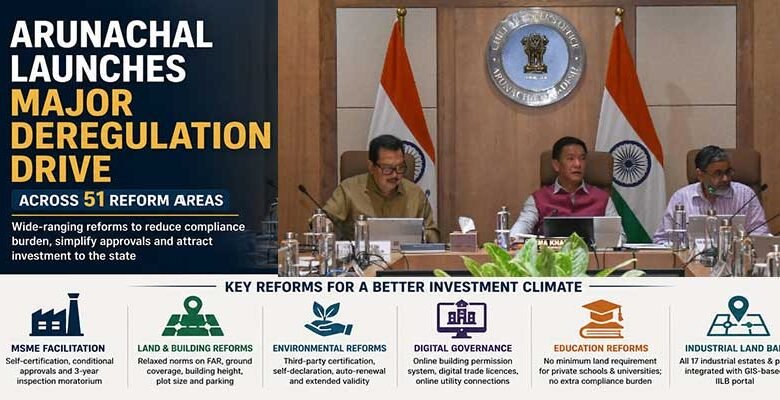
ITANAGAR — Arunachal Pradesh has undertaken one of the most extensive deregulation exercises in its history, introducing reforms across 51 regulatory areas as part of an effort to improve the investment climate, reduce compliance burdens and strengthen ease of doing business in the state.
The reforms, implemented in two phases under the Business Reforms Action Plan (BRAP) framework of the Department for Promotion of Industry and Internal Trade (DPIIT), Government of India, span a wide range of sectors including land administration, urban development, labour regulation, environmental clearances, education infrastructure and utility services.

According to the state government, 16 priority reform areas have already been fully implemented and accepted by the Government of India.
Also Read- Cabinet Reviews Landmark Education Reforms Under Shikshit Arunachal Mission
The reform programme comes as Arunachal Pradesh seeks to position itself as a more investor-friendly destination while balancing development priorities with environmental and social considerations.
One of the key measures is the proposed Arunachal Pradesh MSME Facilitation Ordinance, 2026, which introduces a simplified framework for eligible micro, small and medium enterprises. The ordinance provides for self-certification mechanisms, conditional approvals and a three-year inspection moratorium for eligible enterprises, reducing procedural hurdles for business establishment and operation.
In the industrial sector, the government has introduced significant changes to land-use and building regulations. Industrial land development norms, including floor area ratio (FAR), ground coverage, parking requirements, building height restrictions and minimum plot sizes, have been rationalised to improve land utilisation and facilitate investment.
Also Read- Arunachal Cabinet Approves MSME Ordinance to Simplify Business Operations and Boost Investment
Environmental compliance procedures have also been simplified. The government has introduced third-party certification mechanisms for Consent to Establish and Consent to Operate approvals. In addition, self-declaration systems, auto-renewal provisions and extended validity periods have been operationalised for Green and White category industries.
As part of these reforms, 32 additional industries were included in the White Category list earlier this year, exempting them from certain prior consent requirements.
The state has also expanded digital governance systems aimed at reducing administrative delays. An end-to-end Online Building Permission System has been launched, integrating approvals from multiple departments into a single digital platform. The system also enables third-party inspections for low- and medium-risk buildings.
Also Read- Pema Khandu Inaugurates Bamboo & Cane Technology Centre, Calls Bamboo Arunachal’s ‘Green Gold’
In the education sector, Arunachal Pradesh has removed minimum land ownership requirements for private schools and universities. The government stated that no additional infrastructure or compliance requirements beyond those mandated under national laws and regulatory frameworks will be imposed on private educational institutions.
Officials said the reform is intended to encourage greater private investment in education while maintaining compliance with national standards.
The state has further integrated all 17 industrial estates and industrial parks into the GIS-based India Industrial Land Bank (IILB) portal, enabling prospective investors to access information on land availability through a centralised online platform.
Also Read- Arunachal Launches Finishing Course to Prepare ITI Graduates for Employment and Entrepreneurship
Trade licence issuance and renewal processes have also been digitised, while online systems for electricity and water connections have been introduced to improve service delivery.
Government officials described the reforms as part of a broader strategy to create a transparent, efficient and predictable regulatory environment capable of supporting entrepreneurship, industrial development and private investment.
While deregulation initiatives often seek to improve business efficiency and reduce transaction costs, their long-term impact will depend on implementation, investor response and the ability of institutions to balance economic growth with environmental and community concerns.
The government maintains that the reforms will help strengthen Arunachal Pradesh’s competitiveness while preserving the state’s ecological, cultural and tribal heritage.