Arunachal: Cabinet Reviews Landmark Education Reforms Under Shikshit Arunachal Mission
Cabinet reviews progress of the Shikshit Arunachal Mission, highlighting improved academic performance, digital governance reforms, infrastructure expansion and teacher management initiatives across the state.
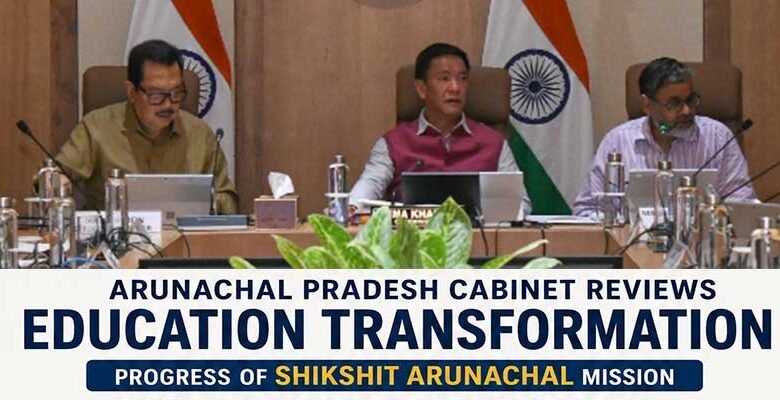
ITANAGAR — The Arunachal Pradesh Cabinet on Tuesday reviewed the progress of the flagship “Shikshit Bharat to Shikshit Arunachal” Mission, describing it as one of the most comprehensive education reform programmes undertaken in the state’s history.
Chaired by Chief Minister Pema Khandu, the Cabinet was informed that the state has invested ₹3,612.50 crore during the first phase of the mission between 2023 and 2026. With a proposed Phase-II investment of ₹1,500 crore, the total expenditure under the programme is expected to exceed ₹5,100 crore by 2029.

According to the government, the mission seeks to improve learning outcomes, strengthen educational infrastructure, modernise governance systems and ensure equitable access to quality education across Arunachal Pradesh, including remote and border areas.
Also Read- Arunachal Cabinet Approves MSME Ordinance to Simplify Business Operations and Boost Investment
One of the key reforms highlighted during the review was the rationalisation of the school network. The number of schools has been streamlined from 2,890 to 1,885, with resources and teacher deployment being consolidated through 538 host schools. Officials stated that the move was intended to improve resource utilisation and educational outcomes.
The Cabinet also reviewed teacher management reforms undertaken during the period. These include the enactment of the Arunachal Pradesh Transfer and Posting Act, 2026 and the introduction of a digital Teacher Registry Portal. Together, these measures have facilitated more than 2,600 merit-based teacher transfers, aimed at improving transparency and addressing staffing imbalances.
Also Read- Pema Khandu Inaugurates Bamboo & Cane Technology Centre, Calls Bamboo Arunachal’s ‘Green Gold’
Digital governance emerged as another major component of the mission. The government has established systems such as the Arunachal Vidya Nidhi (AVN) platform and the Vidya Sameeksha Kendra, enabling real-time monitoring of educational infrastructure, service delivery and school performance indicators.
The Cabinet was informed that the reforms have coincided with improvements in academic performance. According to official data, the CBSE Class X pass percentage has increased by 21.7 per cent, while the Class XII pass percentage has improved by 22.8 per cent, bringing the state’s performance closer to national averages.
The review also noted gains in national education assessments and rankings. Arunachal Pradesh secured the 17th position in the PARAKH Rashtriya Sarvekshan 2024 and registered improvements in both the Performance Grading Index (PGI) and NITI Aayog’s Sustainable Development Goal rankings related to education.
Also Read- Arunachal Launches Finishing Course to Prepare ITI Graduates for Employment and Entrepreneurship
Infrastructure development has formed a major part of the mission’s expenditure. The government reported the construction and upgradation of 50 Golden Jubilee Schools, 90 PM Shri Schools, over 120 hostels, 152 science laboratories, 159 libraries, more than 400 sanitation facilities, 300 PM Poshan kitchens and 180 staff quarters.
Special attention has also been given to inclusive education and capacity building. The state has recruited 150 Special Education Teachers and conducted training programmes benefiting more than 7,000 education stakeholders.
In addition to infrastructure and governance reforms, the mission has incorporated measures aimed at preserving indigenous heritage. The government reported the development and distribution of 75,100 textbooks in ten tribal languages, alongside initiatives to strengthen Bhoti language education.
Also Read- NCC Training Camp and Cultural Selection Process Begins in Itanagar
The Cabinet observed that the reforms have laid the foundation for a more modern, accountable and outcome-oriented education system. It reaffirmed the government’s commitment to achieving universal access to quality education, improved learning outcomes, digital integration and strengthened infrastructure by 2029.
While challenges relating to geography, accessibility and educational equity remain, the government maintains that the mission represents a long-term strategy to transform the state’s education sector and prepare students for future opportunities in an increasingly technology-driven world.