Three-Day Workshop Highlights Potential of GI Products for Rural Prosperity
The three-day programme brought together stakeholders from Arunachal Pradesh and Assam to explore GI registration, value addition, branding and livelihood opportunities.
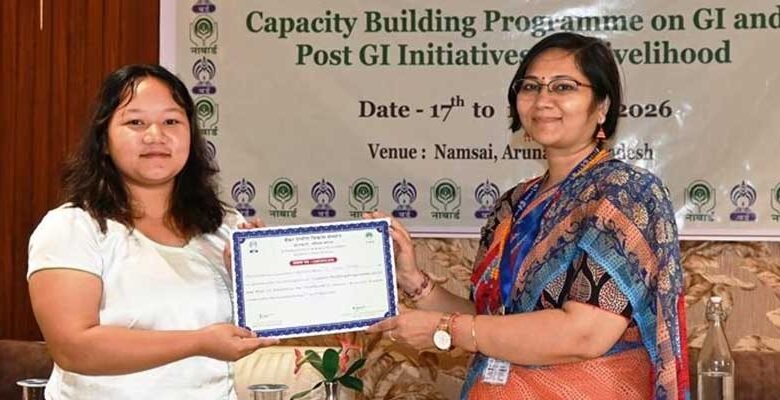
NAMSAI- A three-day Capacity Building Programme on Geographical Indications (GI) and Post-GI Initiatives for Livelihood Promotion concluded successfully at Hotel Namlau in Namsai, with participants gaining practical insights into GI registration, value addition, branding, marketing and sustainable livelihood development.
The programme was organised by the Bankers Institute of Rural Development (BIRD), Kolkata, the apex training institute of NABARD, with the objective of strengthening the capacities of stakeholders engaged in promoting and managing GI products.

Representatives from NGOs, Farmer Producer Organisations (FPOs), Organic Farmer Producer Organisations (OFPOs), government departments and other stakeholders from Arunachal Pradesh and Assam participated in the programme.
During the inaugural sessions, Dr. Bhawana Pal, Faculty Member and Programme Director at BIRD Kolkata, explained the provisions of the Geographical Indications of Goods (Registration and Protection) Act, 1999, and elaborated on the registration process and stakeholder responsibilities. Vivek Anand, Deputy General Manager of NABARD, highlighted the vast potential of GI products in the North Eastern Region to generate sustainable livelihood opportunities and strengthen rural enterprises.
Also Read- Chowna Mein Inaugurates DIY Lab at APIIP, Pushes for Stronger Startup Ecosystem
In an online session, Padma Shri awardee Dr. Rajni Kant, widely known as the “GI Man of India”, shared practical insights on the significance of GI registration and the steps involved in securing GI protection for traditional products.
A key highlight of the programme was an exposure-cum-field visit conducted on the second day to successful GI initiatives in Namsai and Changlang districts. Participants visited the Khaw Tai (Khamti Rice) Processing Unit operated by NOSAAP at Lathao, where they observed scientific processing, grading, packaging and value addition of the GI-tagged rice.
The delegation also visited the Tangsa Textile Handloom Cluster at Nongtham to witness traditional weaving practices and the Choeping Tibetan Cooperative Society at Miao to understand the production process behind GI-tagged handmade carpets. Additional visits to NABARD-supported NAVI Rural Mart at Miao and NOSAAP Rural Mart at Namsai provided participants with practical exposure to branding, marketing and retailing strategies for GI products.
Also Read- Gumin Mize Arrest Sparks Debate as Police Probe Continues
On the concluding day, Prof. (Dr.) Sajjan Choudhuri of Arunachal University of Studies delivered a session on branding and marketing strategies to enhance the commercial value of GI products. Dr. Bhawana Pal discussed challenges faced after GI registration and outlined NABARD’s initiatives to support GI-based producer organisations and livelihood promotion.
Sharing his experience, Chau Athina Chauhai, Chief Executive Officer of NOSAAP, highlighted the journey of promoting GI-tagged Khaw Tai (Khamti Rice) through collective farmer-led efforts. Dusu Tatu, Craft Superintendent of the Department of Textiles and Handloom, informed participants about government schemes aimed at supporting traditional textiles and handloom products.
The programme equipped participants with practical knowledge on GI registration procedures, branding, packaging, market linkage development and institutional support systems. Organisers said the exposure to successful GI enterprises would help participants replicate best practices in their own regions.
Also Read- Arunachal Cabinet Simplifies Land Use Conversion Rules to Ease Development
The training is expected to contribute towards strengthening GI-based entrepreneurship, preserving traditional knowledge systems, improving market access and generating sustainable livelihood opportunities across the North Eastern Region.
The programme was coordinated by Kamal Roy, Assistant General Manager and District Development Manager of NABARD, Namsai. Delivering the vote of thanks, he expressed appreciation to BIRD Kolkata, resource persons, partner institutions and participants for their contributions and emphasized the importance of collaboration among government agencies, producer organisations and local communities in unlocking the full potential of GI products for rural prosperity and inclusive economic development.