80:20 Recruitment Policy Faces Fresh Challenge as Student, Tribal Groups Demand 100% Government Job Reservation for APST Candidates
Student, tribal and youth groups have given the Arunachal Pradesh government an August 15 deadline to abolish the 20% open quota, while the government says any change must withstand legal and constitutional scrutiny.
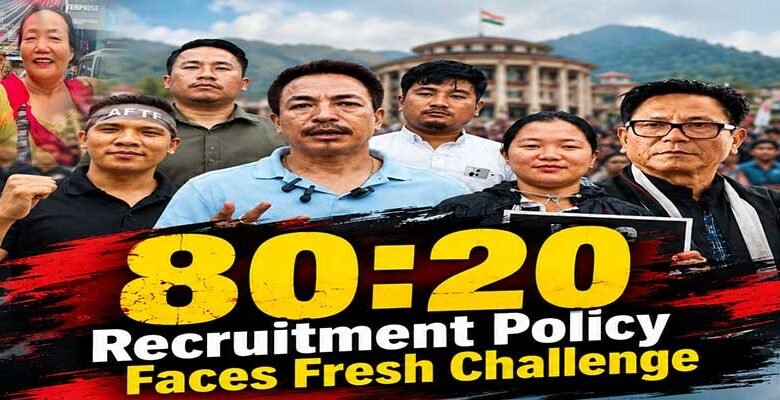
ITANAGAR- The controversy over Arunachal Pradesh’s 80:20 government recruitment policy has intensified, with student, tribal and youth organisations stepping up pressure on the state government to abolish the 20% open quota and provide complete reservation in government employment for Arunachal Pradesh Scheduled Tribe (APST) candidates.
The latest escalation follows a major mobilisation in Itanagar, where thousands of protesters participated in a “Final Mass Referendum Rally” and called for an immediate overhaul of the existing recruitment framework.

The groups have set August 15, 2026, as a key deadline, demanding that the state Cabinet formally scrap the 20% open component of the recruitment system. They have warned of wider protests and possible state-wide shutdowns if the demand is not addressed.
Demand for 100% reservation gains momentum
The 80:20 recruitment system, introduced in 1991, reserves 80% of government jobs for APST candidates, while the remaining 20% is open to unreserved competition.
Organisations leading the current agitation argue that the arrangement no longer reflects the demographic and employment realities of Arunachal Pradesh. They contend that, as a predominantly tribal state, recruitment to government positions should provide stronger protection to indigenous candidates.
Also Read- AAPSU Reaffirms Strong Support for 80:20 Reservation Ahead of HPC Meeting
The demand now being raised by several groups is for 100% reservation of government jobs for APST candidates, accompanied by stricter eligibility requirements for state-level competitive examinations.
Among the key demands is making APST status and a Permanent Resident Certificate (PRC) mandatory for candidates appearing in examinations conducted by the Arunachal Pradesh Public Service Commission (APPSC) and Arunachal Pradesh Staff Selection Board (APSSB).
Student and tribal groups reject further delays
The All Arunachal Pradesh Students’ Union (AAPSU) has also reaffirmed its demand for the complete abolition of the 80:20 ratio.
AAPSU’s demand to make both the Permanent Resident Certificate (PRC) and Scheduled Tribe (ST) certificate mandatory in recruitment processes and other relevant government services. AAPSU think that the move is essential to safeguard the rights and interests of the indigenous people of Arunachal Pradesh.
AAPSU has referred to an earlier High-Level Committee headed by former Education Minister Taba Tedir, whose report was submitted in January 2024. The student body maintains that the findings of the earlier panel should form the basis for a final decision rather than lead to further delays.
Also Read- AAPSU Demands Apology from Minister Nyato Dukam Over 80:20 Reservation Remarks
Other tribal and youth organisations have similarly joined the campaign, arguing that existing recruitment rules allow opportunities to be accessed by candidates from outside the state while local educated youth face intense competition for a limited number of government positions.
Some groups have additionally proposed that knowledge of local tribal languages or dialects should form part of recruitment eligibility criteria for certain state government positions.
Groups cite large number of local candidates
Organisations involved in the agitation have cited participation figures from recent state-level examinations to underline the scale of competition faced by local candidates.
They claim that around 53,000 candidates appeared in recent state services examinations, including more than 35,000 APST applicants.
The groups argue that the figures demonstrate the significant demand for government employment among indigenous youth and strengthen their case for tighter recruitment protections.
However, the demand for complete reservation also raises broader questions about the legal and constitutional framework governing public employment and reservation policies. Any permanent change would therefore need to address both the concerns of local organisations and the legal parameters governing recruitment.
Government stresses legal and constitutional safeguards
The Arunachal Pradesh government has not rejected the demand for stronger protection of local youth but has adopted a cautious approach to changing the existing system.
On July 6, 2026, the government constituted a fresh six-member High-Power Committee (HPC) headed by Industries Minister Nyato Dukam to examine the legal viability, constitutional implications and possible mechanisms for changing the existing 80:20 arrangement.
The government’s concern is that an immediate structural change without adequate legal safeguards could face challenges in court and potentially put existing reservation benefits at risk.
The administration has maintained that any revised recruitment framework must be legally sustainable and should not inadvertently result in the existing protections for APST candidates being weakened or overturned.
Chief Minister Pema Khandu has assured student representatives that the government is treating the issue seriously. The Chief Secretary has reportedly been asked to examine previous committee findings alongside the work of the newly constituted HPC to identify a legally viable way forward.
August 15 deadline puts government under pressure
The immediate focus is now on August 15, the deadline set by organisations demanding the abolition of the 20% open quota.
For the protesting groups, the issue is no longer simply a question of reviewing the recruitment policy but of taking a definitive decision to ensure greater employment protection for indigenous youth.
For the government, however, the challenge is to balance the demand for stronger local safeguards with constitutional and legal considerations that could determine whether any new recruitment policy survives judicial scrutiny.
With the deadline approaching, the government’s response is likely to determine the next phase of the agitation. A decision to move towards abolishing the open quota could ease tensions, while failure to address the demand could trigger a broader round of protests across the state.
The dispute has consequently emerged as a significant test for the Arunachal Pradesh government over how it balances local employment protection, tribal interests and the legal framework governing public recruitment.