Panchayats Key to Viksit Bharat Vision: CM Khandu
Chief Minister Pema Khandu inaugurated a four-day state-level interaction-cum-orientation programme for elected Panchayati Raj Institution representatives in Itanagar.
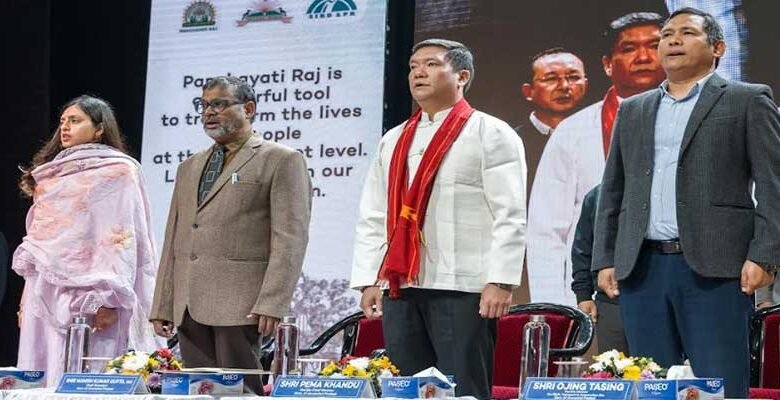
ITANAGAR- Chief Minister Pema Khandu on Thursday called upon elected Panchayati Raj Institution (PRI) representatives to strengthen grassroots democracy through inclusive planning, effective implementation of government schemes and close coordination with the administrative machinery.
Inaugurating the extended four-day State Level Interaction-cum-Orientation Programme (2026–2030) for newly elected PRI representatives, organised by the Department of Panchayati Raj in Itanagar, the Chief Minister congratulated Zilla Parishad Chairpersons (ZPCs), Zilla Parishad Members (ZPMs) and Gram Panchayat Chairpersons (GPCs) on receiving a public mandate in the recent Panchayat elections.

Explaining the structure of the programme, Khandu said the first two days involve joint training sessions for all PRI representatives, followed by two additional days of focused training for ZPMs and GPCs. He said the technical sessions were designed to strengthen the Panchayati Raj system by familiarising representatives with government schemes, emerging technologies and administrative processes.
Also Read- Former Minister Takar Marde Passes Away
Highlighting Arunachal Pradesh’s two-tier Panchayati Raj system, the Chief Minister said the model was adopted to ensure efficiency and role clarity in view of the state’s unique geographical and demographic conditions. He described Panchayati Raj institutions as the foundation of grassroots democracy and stressed that elected representatives play a critical role in translating public aspirations into village development planning.
Sharing data on PRI representation, Khandu said the state has 27 Zilla Parishad Chairpersons, 245 Zilla Parishad Members and 2,108 Gram Panchayat Chairpersons, along with over 8,000 Gram Panchayat Members. He added that due to space constraints, only 50 per cent of GPCs were invited for the current programme, with district-wise and zonal-level training planned subsequently.
Also Read- Mishmi Takin Statue Unveiled at Anini Town
The Chief Minister said delimitation of Panchayati Raj institutions would be undertaken in the next election cycle following the upcoming census, noting that the State Election Commission has already been empowered to carry out the exercise.
Referring to national development goals, Khandu said India has emerged as the world’s fourth-largest economy and is expected to become the third-largest in the near future. He said the vision of “Viksit Bharat 2047” can only be achieved through the development of villages, placing Panchayati Raj institutions at the centre of rural transformation.
Also Read- Arunachal CM Urges Panchayat Leaders to Strengthen Democracy
He highlighted governance initiatives such as Seva Aapke Dwar and Cabinet Aapke Dwar, stating that these programmes have enabled direct delivery of services to over 15 lakh people while helping the government identify ground-level challenges.
Reaffirming the autonomy of Panchayati Raj institutions, the Chief Minister assured that there would be no interference by MLAs in Panchayat functioning. He said complaints related to interference had been taken seriously and reiterated that Panchayats are independent bodies empowered to carry out their responsibilities.
Khandu said Arunachal Pradesh is among the first states to allocate 10 per cent of its state-owned resources directly to the Panchayati Raj system over the last five years, resulting in increased grants as the state’s economy expands. He also highlighted the adoption of digital platforms, e-governance tools, online audits, PFMS and gender inclusion frameworks to enhance transparency and efficiency.
Welcoming the replacement of MGNREGA with the Viksit Bharat Gramin Rozgar aur Aajeevika Guarantee Mission (VBGRAM), the Chief Minister said the new scheme guarantees 125 days of employment and focuses on water security, rural infrastructure, livelihood enhancement and disaster mitigation through need-based village planning.
The Chief Minister urged PRI representatives to adopt participatory planning, ensure inclusion of all households and prioritise the upliftment of vulnerable sections. He also stressed convergence among schemes of different departments to maximise development outcomes.
Khandu said the government has constructed 1,182 Panchayat Bhawan-cum-Common Service Centres and completed District Panchayat Resource Centres in five districts, with three more nearing completion. He also highlighted increased participation of women in Panchayati Raj, with representation nearing 48–50 per cent.
He further emphasised the role of women and Self-Help Groups (SHGs) in strengthening the rural economy, noting that over 1.4 lakh women are engaged in SHG activities in the state. He said PRI representatives should integrate SHGs into local development planning.
Calling the five-year tenure a rare opportunity for public service, the Chief Minister urged elected representatives to work with urgency, accountability and innovation. He said strong coordination between Panchayats, district administration and the state government would be essential to transform villages and position Arunachal Pradesh as a model of grassroots governance.
PRI Minister Ojing Tasing, Advisor to the PRI Minister Taniya Soki, Chief Secretary Manish Kumar Gupta and Panchayati Raj Secretary Sonal Swaroop were present at the programme, among others.