Arunachal: Court Grants Bail to IAS Officer Talo Potom
The court observes no prima facie evidence of abetment, granting IAS officer Talo Potom bail after his surrender on October 27.
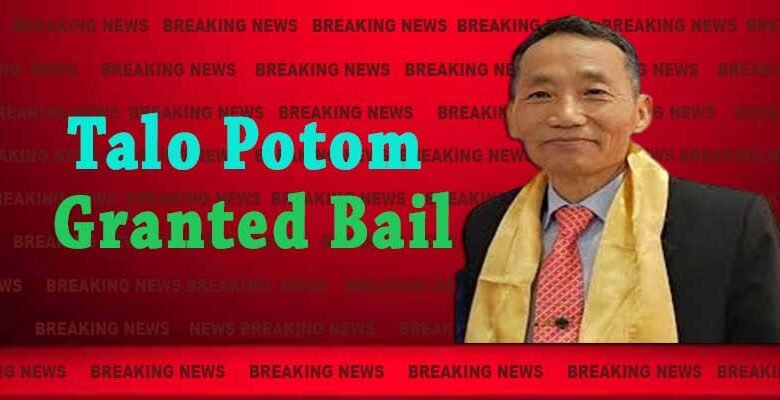
ITANAGAR- In a key legal development, the court has granted bail to IAS officer Talo Potom on a ₹1 lakh personal bond, observing that there was no prima facie evidence linking him to the alleged abetment of suicide that led to his arrest.
Potom, a senior bureaucrat serving in the Arunachal Pradesh government, had surrendered voluntarily before the police on October 27 following allegations of abetment. He was subsequently remanded to judicial custody, drawing widespread public and media attention.

In its bail order, the court noted that the prosecution had not established direct or circumstantial evidence suggesting Potom’s involvement in the alleged act. The judge emphasized that “mere allegations or conjectures cannot substitute for proof at the stage of bail consideration.”
Also Read- Indian Army Launches Mount Kangto Expedition
The decision brings significant relief to the officer, who had faced mounting scrutiny and speculation over the past week. Legal experts describe the order as a reaffirmation of the principle that bail is the norm and jail the exception, particularly in cases where the evidence remains inconclusive.
While the court’s observations are limited to the bail stage, the ruling is expected to influence the direction of the ongoing investigation. Sources close to the legal proceedings indicated that Potom has cooperated fully with investigators and maintained that he has “nothing to hide.”
Also Read- Farmers Trained on Seed Quality Control in Tawang
As per legal procedure, the IAS officer has been directed to not tamper with evidence or influence witnesses and to cooperate with the inquiry as it continues.
The case has drawn widespread public interest in Arunachal Pradesh, where Potom, known for his administrative work and public outreach, has served in several key postings. The court’s finding of no prima facie evidence is being viewed as a temporary but crucial reprieve for the bureaucrat, pending further investigation.