
Dhaka Erupts After Death Verdict for Ousted PM Hasina
International Crimes Tribunal sentences former PM Sheikh Hasina to death in absentia for the 2024 protest crackdown, triggering violent unrest across Bangladesh.
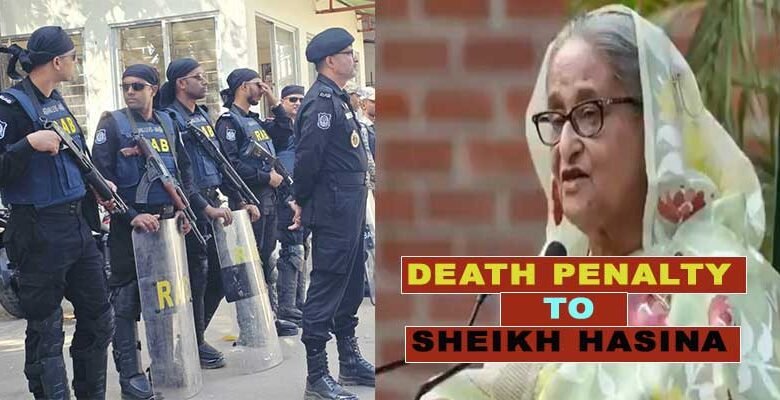
DHAKA ( Bangladesh )- Bangladesh’s political landscape was thrown into turmoil on Monday after the International Crimes Tribunal (ICT) sentenced former Prime Minister Sheikh Hasina to death in absentia, holding her responsible for crimes against humanity committed during the 2024 student-led uprising. The ruling marks a defining moment in the country’s post-Hasina transition and has triggered widespread violence across Dhaka and other cities.
Hasina, 77, fled Bangladesh in August 2024 following mass demonstrations demanding reforms to the quota system and protesting alleged authoritarian excesses. Prosecutors described her as the “architect” of the state’s violent response, which resulted in more than 1,400 deaths and thousands of injuries. The tribunal’s three-member bench delivered the judgment in a packed courtroom, calling the crackdown “systemic, coordinated, and executed with state sanction.”

The court also awarded the death penalty to former Home Minister Asaduzzaman Khan Kamal, while former police chief Chowdhury Abdullah Al-Mahmud received a five-year prison term. Compensation for victims’ families was ordered, underscoring the tribunal’s acknowledgment of the scale of state violence during the July 2024 protests.
Also Read- Flying Car takes to the skies of Slovakia-Watch Video
The verdict quickly ignited fresh unrest. Anti-Hasina demonstrators celebrated outside the tribunal, while Awami League supporters clashed with them, sparking arson attacks, vandalism, and street battles. At least 28 people were reported dead as crude bombs, stones, and gunfire were exchanged in parts of Dhaka.
Offices linked to Nobel laureate and interim government head Muhammad Yunus were vandalised, prompting authorities to impose shoot-on-sight curfews in several districts. Internet restrictions were introduced, and schools and markets were closed as security forces, including the Border Guard Bangladesh (BGB), attempted to restore order. The unrest comes ahead of the February 2026 elections, in which the Awami League has been disqualified from participation.
Also Read- Britain Woman made over 10 Lakh Rupee selling her breast milk to bodybuilders
Human rights groups cautiously welcomed the verdict as a step toward accountability, while critics—including Awami League supporters and Hasina’s son, Sajeeb Wazed—condemned it as politically motivated. Observers note that Hasina, who has lived in India since her exile, now sits at the center of a diplomatic standoff. Bangladesh’s Foreign Ministry has formally requested her extradition, while India’s Ministry of External Affairs has stated only that it is “monitoring developments.”
Also Read- Sheikh Hasina Flees Bangladesh, Lands At Hindon Airbase Near Delhi
The ruling arrives at a moment of heightened fragility for Bangladesh. Economic growth has slipped to 4.5 percent amid political instability, and tensions between religious and ethnic groups have worsened. International organisations, including the United Nations, have appealed for restraint and urged the interim government to safeguard the integrity of the upcoming elections.
For many in Dhaka, the verdict represents both a symbolic reckoning and a potential flashpoint. While the death sentence is unlikely to be enforced unless Hasina is extradited, its political and social implications are profound. As security forces patrol the streets and nighttime curfews deepen public anxiety, Bangladesh enters an uncertain new chapter marked by accountability on the one hand and volatile unrest on the other.
( Sources- Various TV reports )