Arunachal: CAU Pasighat Hosts Maize Pest Management Programme
A three-day training-cum-input distribution programme under an ICAR-funded project focused on integrated pest management practices for maize cultivation in East Siang district.
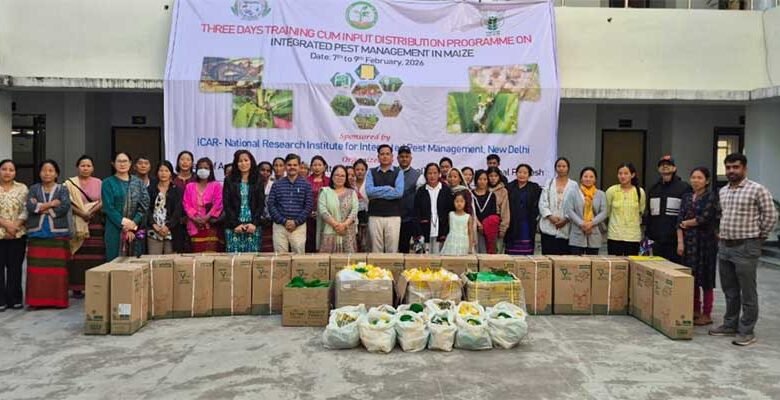
PASIGHAT — A three-day training-cum-input distribution programme on “Integrated Pest Management (IPM) in Maize” was conducted at the College of Agriculture, Central Agricultural University (Imphal), Pasighat, Arunachal Pradesh, from February 7 to 9, 2026. The programme was organised for farmers of Sikabamin village in East Siang district.
The training was held under an Indian Council of Agricultural Research–funded project of the National Research Institute for Integrated Pest Management, New Delhi, titled “Establishment of Crop Based Model IPM Villages for Promotion of Integrated Pest Management Technologies in NEH Region of India”.

A total of 45 farmers participated in the programme. Over the three days, 14 lectures, including hands-on training sessions, were delivered by faculty members from the College of Agriculture as well as the College of Horticulture and Forestry, CAU(I), Pasighat.
Also Read- Meeting Held on Demarcation of Ziro Municipal Area
The Dean of the College of Agriculture, Dr. Sanjay Swami, attended both the inaugural and valedictory sessions and addressed participants on the role of beneficial soil microbes in sustainable crop protection. During the technical sessions, Dr. Naorem Yaiphabi Chanu, organising secretary of the programme, explained the principles of IPM, identification of major insect pests affecting maize, and farmscaping-based habitat manipulation. She also demonstrated the use of pheromone and light traps and the preparation of neem seed kernel extract (NSKE) for eco-friendly pest management.
Also Read- Farmers Trained on Bio-fortified Rice Varieties in Tawang
Dr. R. C. Shakywar spoke on the importance of maize in local farming systems and yield losses caused by crop diseases, while Dr. Gireesh Chand delivered a session on integrated disease management in maize. Other faculty members, including Dr. Denisha Rajkhowa and Dr. Ajaykumara K. M., shared insights on the role of biocontrol agents in IPM and the on-farm preparation of natural farming inputs.
As part of the programme, agricultural inputs such as knapsack sprayers and pheromone traps for managing fall armyworm infestation were distributed among the participating farmers. Officials said the initiative aimed to strengthen farmers’ capacity to adopt environmentally sustainable pest management practices in maize cultivation.