Arunachal: Headmaster Drives Students 110 km for Exams
In remote Arunachal, a headmaster’s daily 110 km drive during CBSE exams highlights the structural challenges rural students face — and the power of individual intervention.
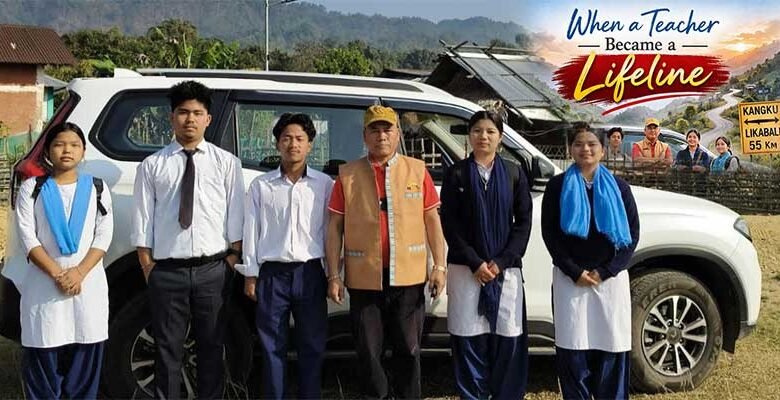
KANGKU/LIKABALI- As the Central Board of Secondary Education (CBSE) examinations began this year, five students from the small hill settlement of Kangku confronted a challenge that had little to do with textbooks or preparation. Their examination centre was located 55 kilometres away in Likabali — a journey that, in urban settings, might seem routine but in remote terrain becomes a daily test of endurance and affordability.
For families with limited financial means, arranging transportation or temporary accommodation in town posed a significant burden. The cost of hiring a vehicle for multiple days or staying in hotels was beyond reach. At a time when students are expected to focus solely on performance, these candidates faced an additional layer of uncertainty — whether they could reliably reach their examination hall each morning.

It was in this context that Bomto Bole, Headmaster of Kangku, intervened.
Without formal mandate or institutional funding, he began driving the students to Likabali in his private vehicle each day, covering approximately 110 kilometres daily through winding hill roads. The decision, according to local residents, was neither ceremonial nor publicised at the outset. It emerged from a recognition of need.
Also Read- Lhakpa Tsering Crowned Mr Arunachal 2026
In many rural and border regions of Arunachal Pradesh, educational access extends beyond classroom teaching. Infrastructure gaps — including limited transport networks and dispersed settlements — often shape a student’s academic trajectory. Examination centres are frequently centralised in larger towns, compelling rural candidates to travel long distances during crucial academic periods.
By providing daily transport, Bole effectively reduced both financial strain and psychological stress for the students and their families. Community members observed that the gesture allowed the candidates to approach their exams with greater calm and stability.
Also Read- Chochi Meyor Conferred Innovative Farmer Award
Education policy discussions often focus on curriculum reform, digital access and examination reforms. Yet stories from remote regions reveal another dimension: the physical and economic barriers that continue to define educational access.
Observers note that while systemic improvements in infrastructure remain essential, individual acts of responsibility frequently bridge immediate gaps. In this case, a headmaster’s personal vehicle became a temporary extension of the education system itself.
Also Read- Five Stolen Two-Wheelers Recovered in Pasighat
For the five students involved, the board examinations may eventually be remembered for marks and results. But the journey to the examination centre — undertaken each day under the care of their teacher — reflects a broader reality of rural education in India: opportunity often depends not only on policy frameworks, but on human intervention.
In Kangku, a daily car ride quietly underscored a larger question — how many other students across remote regions face similar obstacles without such support?