NDA Sweeps Bihar Polls With 202-Seat Landslide
The NDA recorded an unprecedented 202-seat victory in the 2025 Bihar Assembly elections, as BJP and JD(U) surged and the Mahagathbandhan suffered one of its worst defeats.
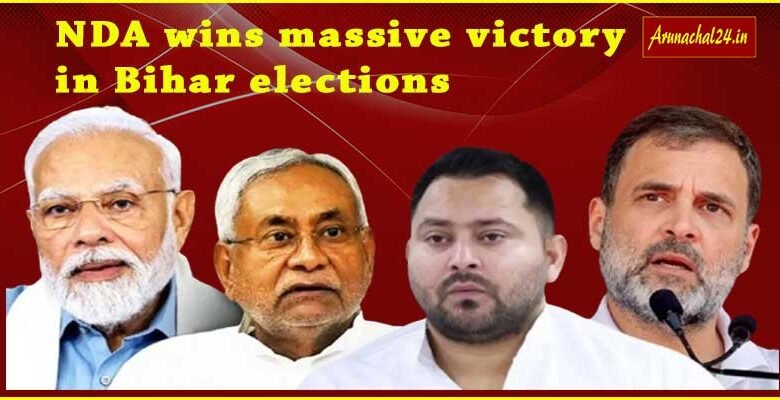
NEWS DESK- The Bihar Assembly elections delivered a decisive and historic mandate in favour of the National Democratic Alliance (NDA), which secured 202 of the 243 seats, cementing its dominance in a politically volatile state long shaped by caste equations and development claims. The results marked a severe setback for the opposition Mahagathbandhan (MGB), which collapsed to just 36 seats, raising questions over its strategy, leadership, and organisational coherence.
NDA’s Commanding Performance

The NDA’s victory was anchored by the Bharatiya Janata Party (BJP) and Janata Dal (United) [JD(U)], both of which registered sweeping gains across regions and caste blocs.
The BJP emerged as the single-largest party with 89 seats, improving upon its 2020 tally of 74. Its aggressive mobilisation of upper castes, non-Yadav OBCs, and urban voters translated into a significant rise in vote share, touching 38.5%, nearly doubling its previous performance.
High-profile wins—such as Vijay Kumar Sinha retaining Patna Sahib with a margin of 28,000—reflect the party’s strengthened urban foothold. Prime Minister Narendra Modi’s 15 rallies framed the election as a referendum on “double-engine growth,” amplifying the BJP’s narrative.
Parallelly, Nitish Kumar’s JD(U) staged a dramatic resurgence, securing 85 seats, a substantial jump from 43 in 2020. Consolidation among Kurmi-Koeri voters and targeted welfare promises—ranging from agricultural electricity subsidies to women-centric schemes—helped the party revive its “Sushasan” appeal. Nitish Kumar’s win in Bihar Sharif by over 20,000 votes underscored his enduring relevance among OBC electorates.
Smaller allies, including LJP(RV) with 19 seats and HAM(S) with 5, provided cushion in caste-specific pockets. Collectively, the NDA’s seat share soared to over 80%, bolstered by a 67.14% voter turnout, with substantial participation from women (71%) and youth (65%).
Alliance Performance Table (NDA)
| Alliance/Party | Seats Won (2025) | Seats Won (2020) | Vote Share (2025) | Key Gains/Losses |
|---|---|---|---|---|
| NDA Total | 202 | 125 | 62.8% | +77 seats; swept 18 of 38 districts |
| BJP | 89 | 74 | 38.5% | +15; strong urban gains |
| JD(U) | 85 | 43 | 22.3% | +42; OBC consolidation |
| Others (LJP, HAM) | 28 | 8 | 2.0% | +20; caste-aligned boosts |
( Data May Vary in Final Result )
Mahagathbandhan’s Collapse
The MGB’s slide to 36 seats marks a dramatic fall from its 2020 tally of 110, exposing structural weaknesses and signalling voter fatigue. The Rashtriya Janata Dal (RJD), despite retaining pockets of Yadav-Muslim support, was reduced to 25 seats, a sharp drop from its earlier 75. Tejashwi Yadav’s victory in Raghopur reaffirmed his personal base but did little to arrest a broader decline in support, as the party’s vote share slipped to 21.2%.
The Indian National Congress (INC) endured its worst-ever result in the state, winning only six seats, down from 19 in 2020. The party was virtually wiped out in Seemanchal, further deepening its crisis in the Hindi heartland. Internal dissent over seat-sharing and strategic drift became more pronounced after the results.
Left partner CPI(ML)L, with five seats, saw reduced influence, reflecting shifting allegiances even in traditionally sympathetic constituencies.
Alliance Performance Table (MGB)
| Alliance/Party | Seats Won (2025) | Seats Won (2020) | Vote Share (2025) | Key Gains/Losses |
|---|---|---|---|---|
| MGB Total | 36 | 110 | 14.9% | -74 seats; retained <20% districts |
| RJD | 25 | 75 | 21.2% | -50; Yadav-Muslim base intact |
| INC | 6 | 19 | 5.8% | -13; urban collapse |
| Others (CPI(ML)L) | 5 | 16 | 2.1% | -11; weakened cadre |
( Data May Vary in Final Result )
The Road Ahead
Nitish Kumar is poised for his fifth term as Chief Minister, though the BJP’s numerical superiority may recalibrate the power balance within the alliance. Governance challenges—including the proposed second Patna airport, employment generation, and caste census implementation—will test the NDA’s promise-oriented campaign.
For the MGB, the results have triggered an internal churn. Questions loom over whether the RJD will pursue a solo strategy and whether the Congress can remain electorally relevant. As Bihar transitions from campaign fervour to governance expectations, the NDA faces the task of converting its sweeping mandate into durable outcomes.