Lower Subansiri Achieves 100% Tap Water Coverage Under Jal Jeevan Mission
With 5,740 rural households now connected to functional tap water supply, the district has established a technical roadmap to ensure long-term sustainability and water source protection.
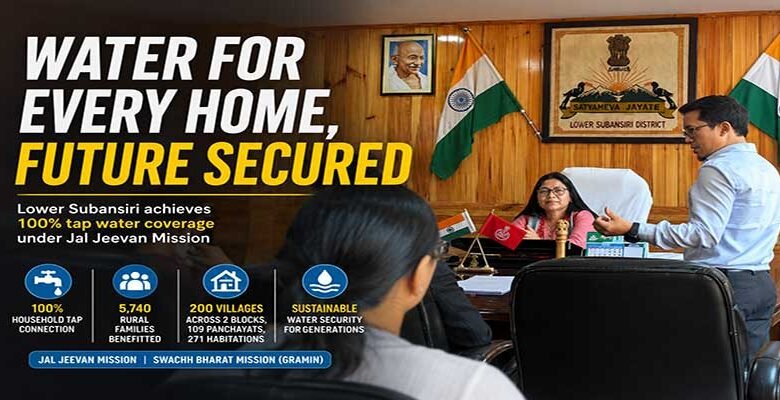
ZIRO- Lower Subansiri district has achieved 100% Functional Household Tap Connection (FHTC) coverage under the Jal Jeevan Mission (JJM), marking a significant milestone in rural water infrastructure and service delivery in Arunachal Pradesh.
The achievement was highlighted during a strategic meeting of the District Water and Sanitation Mission (DWSM) held at the district headquarters in Ziro under the chairmanship of Deputy Commissioner Oli Perme. The meeting focused on strengthening long-term water security, improving institutional mechanisms, and ensuring the sustainability of rural water supply systems across the district.

Officials stated that the district’s full tap water coverage now extends across two administrative blocks, 109 gram panchayats, 200 villages and 271 habitations. As a result, 5,740 rural households have access to clean drinking water through household tap connections.
Also Read- 21 Killed in Massive Fire at Hotel-Restaurant Building in South Delhi’s Malviya Nagar
The meeting commenced with a welcome address by the Executive Engineer of the Public Health Engineering Department (PHED) and brought together senior district officials and departmental representatives to review ongoing initiatives under the Jal Jeevan Mission and the Swachh Bharat Mission (Gramin).
To support the maintenance and sustainability of the newly established infrastructure, the DWSM approved the formation of a District Technical Unit (DTU). The 10-member technical team, comprising engineers, laboratory assistants, consultants and operators, will provide professional oversight, technical guidance and regular monitoring of rural water supply systems.
Also Read- 350 Cadets Participate in 10-Day NCC Training and Disaster Preparedness
Officials said the creation of the DTU is aimed at ensuring that infrastructure created under the Jal Jeevan Mission remains functional and efficient over the long term. The team will work closely with local communities and implementing agencies to address operational challenges and improve service delivery.
The meeting also reviewed recommendations presented by the Source Finding Committee (SFC), chaired by the Executive Engineer of the Water Resources Department, Ziro. The committee has been tasked with identifying and protecting sustainable water sources capable of meeting future demand while withstanding seasonal fluctuations and climate-related pressures.
Also Read- Rajiv Gandhi University Hosts AIFF D Certificate Coaching Course for Aspiring Football Coaches
Recognising the importance of source sustainability, the DWSM emphasized the need for scientific assessment and conservation of water resources to ensure uninterrupted supply to rural households.
As part of its future roadmap, the mission also discussed extending water supply infrastructure to newly emerged habitations, strengthening Village Water and Sanitation Committees (VWSCs), improving revenue collection mechanisms and implementing the “Jal Seva Ankalan” framework to monitor service delivery standards.
Officials noted that while achieving universal household tap connectivity represents a major milestone, sustained focus on operation, maintenance and community participation will be critical to ensuring long-term success.
The District Water and Sanitation Mission, functioning under the leadership of Deputy Commissioner Oli Perme, continues to oversee the implementation of key rural development initiatives related to drinking water supply and sanitation in the district. The latest achievement places Lower Subansiri among the districts that have successfully met the core objective of providing functional tap water access to every rural household under the Jal Jeevan Mission.