NEFA-Era Healthcare Pioneer Ume Perme Passes Away in East Siang
The veteran pharmacist, who served in Arunachal Pradesh's remote areas from 1972 until 1992, played a key role in providing healthcare during disease outbreaks in Lower Mebo and also assisted Army personnel deployed in the border region.
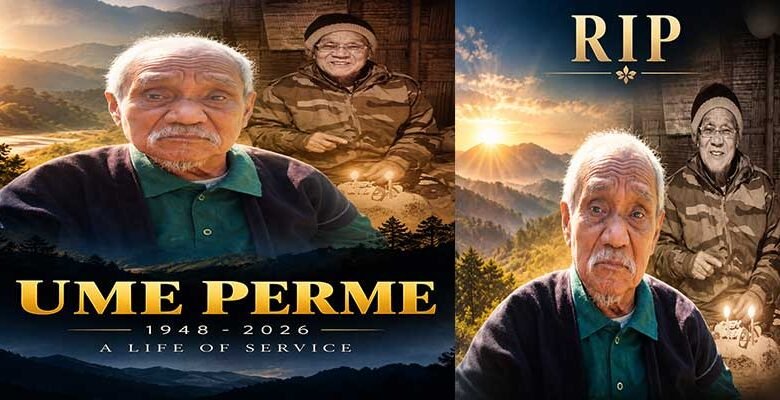
PASIGHAT- Veteran pharmacist and social worker Ume Perme, who dedicated decades to providing healthcare in remote and underserved areas of Arunachal Pradesh, died at his residence in New Borguli village under Mebo Sub-Division of East Siang district at around 4 am on Thursday. He was 77.
Perme, who served in government healthcare from the North-East Frontier Agency (NEFA) era, was remembered for his commitment to rural communities, particularly his efforts to treat patients during major disease outbreaks in Lower Mebo and provide medical assistance in difficult border areas.

According to family and community accounts, he died following a prolonged illness.
Four decades of public service
Born on December 30, 1948, to Gumin Perme and Yamoni Perme, Ume Perme, formerly known as Umeshwar Perme, received his education at the present-day Government Higher Secondary School in Mebo and IGJ Government Higher Secondary School in Pasighat.
He joined government service as a pharmacist on January 12, 1972, when Arunachal Pradesh was still administered as NEFA. He continued serving until his retirement on February 1, 1992.
Also Read- Arunachal Pradesh, Assam Agree to Fast-Track Boundary Demarcation in 33 Disputed Villages
His first posting was at Siyum Circle in Upper Subansiri district, a remote area near the Indo-China border. During his four-year tenure there, he provided essential medical services to communities facing difficult geographical conditions and limited access to healthcare.
Perme and his medical team also assisted Indian Army personnel deployed along the international border, treating altitude-related health complications and other ailments associated with the harsh mountainous environment.
After Siyum, he served at Koyu and Sille before being transferred to the health centre in his native Borguli village, where he continued working until retirement.
Also Read- L. Murugan Resigns from Modi Government, Seeks to Return to Grassroots Politics
Key role during disease outbreaks in Lower Mebo
Perme’s contributions were particularly significant during public health emergencies, when healthcare facilities and trained personnel were scarce.
In 1985, he played an important role in responding to an outbreak of bloody dysentery in villages across Lower Mebo. The Borguli Health Centre, now upgraded to a Primary Health Centre (PHC), was then the only healthcare facility serving the entire region.
His commitment was again evident during the malaria epidemic of 1987. According to accounts of his service, he worked long hours to provide treatment and medical assistance to affected residents across the Monggu-Banggo villages of Lower Mebo.
Also Read- Rahul Gandhi Claims 200 ED, CBI and MEA Officials Are in Touch With Opposition
With no regularly posted medical doctor available at the time, Perme took on substantial responsibilities in overseeing the health centre and coordinating medical services.
His work during these outbreaks reflected the importance of frontline healthcare personnel in areas where access to doctors, medicines and medical infrastructure was limited.
Service extended beyond his official duties
Beyond his government responsibilities, Perme participated in social welfare and community development activities.
He extended assistance to residents of the leprosy colony in Pasighat and contributed to community activities at Rengging village during the early construction of the Pasighat-Pangin road, when he was still a student.
His career represented a generation of healthcare workers who served isolated settlements at a time when transportation, communication and medical facilities were considerably less developed than they are today.
His service in remote villages and his response to disease outbreaks remain an important part of the local community’s public healthcare history.
Mebo MLA pays tribute
Mebo MLA Oken Tayeng expressed grief over Perme’s death and paid tribute to his contributions to healthcare and social welfare in the region.
Recalling his service to rural communities, particularly in Lower Mebo, Tayeng said Perme’s contributions would be remembered with respect and gratitude.
The MLA also conveyed condolences to the bereaved family and wished them strength and courage in coping with the loss.
Perme was predeceased by his wife, Abul Tayeng Perme. He is survived by five sons, three daughters and several grandchildren.
His death marks the loss of a veteran healthcare worker whose decades of service helped bring essential medical care to underserved communities during the formative years of Arunachal Pradesh’s public health system.