Anganwadi Workers Trained in Early Learning, Literacy and Child Development in Diyun
The two-day training held on October 13–14 marks the beginning of a multi-year initiative to strengthen early learning, child development and school readiness across all 69 Anganwadi Centres in Diyun Block.
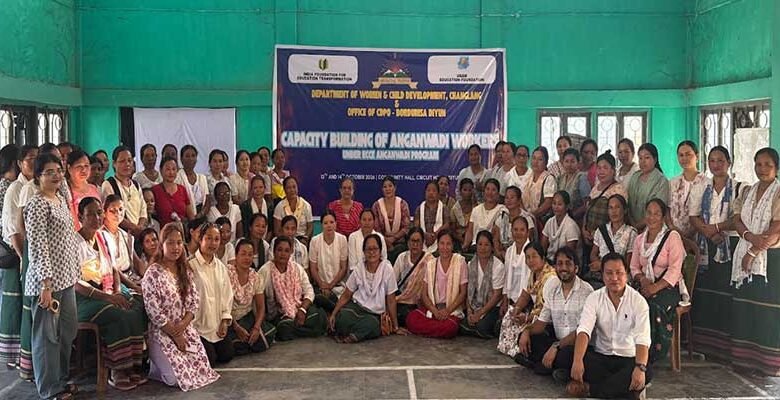
DIYUN, Changlang District- A total of 69 Anganwadi Workers representing all 69 Anganwadi Centres in Diyun Block have participated in a two-day capacity-building programme aimed at strengthening early childhood care, education and school readiness among young children.
The training was organised on October 13 and 14 by the Department of Women and Child Development (WCD), Changlang District, in partnership with the India Foundation For Education Transformation (IFET) and Ugam Education Foundation. The programme was conducted at the Community Hall, Circuit House, Diyun, and the NALC (Circle Library), Diyun.

The initiative marks the beginning of a structured, multi-year capacity-building programme designed to improve the knowledge, skills and classroom practices of Anganwadi Workers, with particular emphasis on children aged three to six years.
The programme is being implemented under the guidance of the WCD Department, Changlang District, headed by Deputy Director, ICDS, Onyok Panyang, and monitored at the project level by K.T. Tungkhang, Child Development Project Officer of the Bordumsa-Diyun ICDS Project.
Also Read- Tawang Administration Plans for Winter Power Cuts, Seeks Public Cooperation
Focus on Early Learning and Child Development
The first training session focused on understanding young children and the different domains of their development, including language, literacy, numeracy, physical development and socio-emotional learning.
Participants took part in discussions, group activities, demonstrations, storytelling, songs, rhymes, movement exercises and pre-mathematical activities. The sessions also encouraged Anganwadi Workers to reflect on their existing responsibilities and daily routines, with greater attention to early learning and school readiness.
An important component of the programme was encouraging workers to recognise children’s strengths, abilities, interests and developmental needs rather than focusing primarily on their limitations.
The training also explored ways to conduct engaging learning activities using locally available materials, making early education more accessible and relevant to children in the community.
Also Read- Eviction Drive Clears Encroachments Along Koloriang Ring Road Alignment
Activity-Based Approach to School Readiness
The second day focused on early language and literacy, pre-mathematical concepts, socio-emotional learning and the development of an integrated daily routine for Anganwadi Centres.
Participants worked in groups to design a model day for young children, incorporating storytelling, songs, movement, mathematics, socio-emotional learning and free play.
At the conclusion of the programme, each participant identified one change to make in her existing practice, one activity to introduce and one behaviour to consciously change at her Anganwadi Centre.
The training was facilitated by Lopa Gandhi, Chief Executive Officer of Ugam Education Foundation; Sanjay Jha, Chief Operating Officer of Ugam Education Foundation; and Prahlad C., Chief Executive Officer of IFET.
Also Read- First-Ever Keyi Panyor Bird Count Records 38 Species in Two Hours
Multi-Year Initiative Across 69 Anganwadi Centres
The partnership between the WCD Department, IFET and Ugam Education Foundation aims to provide sustained professional support to Anganwadi Workers through subsequent training cycles, field-level guidance and opportunities for reflection and improvement.
The initiative also includes the development of model demonstration centres and seeks to strengthen the Early Childhood Care and Education (ECCE) component of Anganwadi services.
Anganwadi Centres play a role beyond nutrition and childcare by providing opportunities for children’s cognitive, language, physical and socio-emotional development before they enter formal schooling. Strengthening these early learning experiences can help children develop foundational skills and become better prepared for school.
The organisers emphasised that improving early childhood education requires sustained investment in the people who work directly with young children, rather than relying solely on one-time training programmes.
With all 69 Anganwadi Centres in Diyun Block covered by the initiative, the next phase will focus on translating the training into everyday classroom practices.
The shared objective of the participating institutions is to ensure that children receive nurturing care, meaningful early learning opportunities and a stronger foundation for formal education.