Anjaw Farmers Gain New Option for Oyster Mushroom Cultivation Using Local Crop Waste
A farm-level trial by KVK Anjaw found millet straw, large cardamom residue and paddy straw performed well, while banana straw also showed encouraging yield potential.
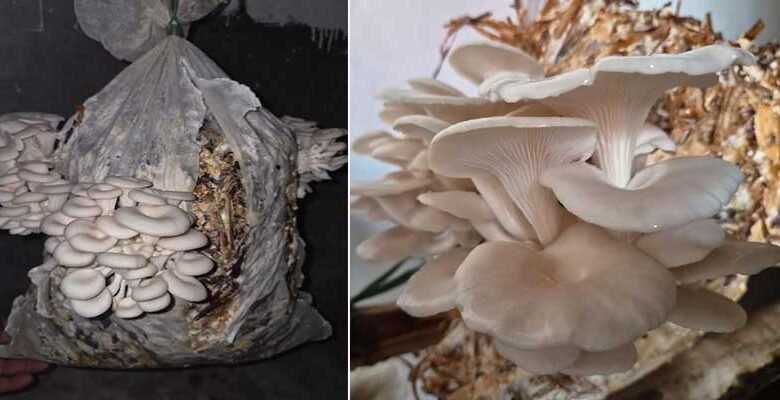
ANJAW- A comparative farm-level trial conducted by Krishi Vigyan Kendra (KVK), Anjaw has successfully validated the use of four locally available agricultural residues as substrates for oyster mushroom cultivation, highlighting a potential new avenue for income generation and sustainable crop-residue utilization in the district.
The trial tested banana straw, paddy straw, millet straw and large cardamom residue for cultivating oyster mushroom (Pleurotus sajor-caju) under the agro-climatic conditions of Anjaw. The objective was to assess whether agricultural biomass readily available to local farmers could be effectively used for mushroom production.

The trial recorded pinhead initiation across all four substrates within 15 to 20 days after spawning, followed by successful mycelium growth, confirming their suitability as potential substrates for oyster mushroom cultivation.
Also Read- Supreme Court Resumes Monitoring of CBI Probe into Arunachal Contract Allegations
Among the four materials, millet straw, large cardamom residue and paddy straw performed well, while banana straw also showed encouraging performance and comparative yield potential under the trial conditions.
The performance of millet straw and large cardamom residue is particularly significant because these materials are locally available crop residues that may otherwise remain underutilized. Their successful use as mushroom-growing substrates could provide farmers with an additional productive use for agricultural biomass.
The findings also suggest that farmers do not necessarily have to depend exclusively on conventional mushroom substrates. Instead, substrate selection could be based on local availability, accessibility and production potential, giving farmers greater flexibility in adopting mushroom cultivation.
Also Read- 29-Year-Old Man Swept Away in Nyamjangchu River in Tawang
According to KVK Anjaw, the successful validation of all four substrates represents a farm-level technology intervention demonstrating that oyster mushroom cultivation can be adapted to locally available biomass resources.
The intervention could have wider implications for hill farming systems, particularly through waste-to-wealth conversion, livelihood diversification, nutritional security and sustainable utilization of agricultural residues. The KVK has identified the encouraging performance of millet straw and large cardamom residue as a basis for further farmer training, demonstrations and wider dissemination of the technology.
The technology concept was conceived by Dr. Debasis Sasmal, Senior Scientist and Head, KVK Anjaw, while the validation was undertaken by Dr. S. Peter Singh, SMS, Agricultural Economics, KVK Anjaw.
Also Read- Queers Ki Kahani Creates Safe Space for LGBTQIA+ Community in Naharlagun
Following the successful validation, KVK Anjaw plans to expand the technology horizontally among farmers, farm women and rural youth, with the stated objective of turning agricultural residues into productive sources of income and employment.
The trial therefore presents oyster mushroom cultivation not only as an alternative farm activity but also as a potential way to convert locally available agricultural residues into a productive resource, particularly in the hill farming systems of Arunachal Pradesh.