
China Begins Work on World’s Largest Dam; India Accelerates 11,000 MW Siang Project
As China advances construction of a 60,000 MW hydropower complex on the Yarlung Tsangpo in Tibet, India is moving ahead with the proposed 11,000 MW Siang Upper Multipurpose Project in Arunachal Pradesh, triggering debates over water security, ecology, displacement and regional geopolitics.
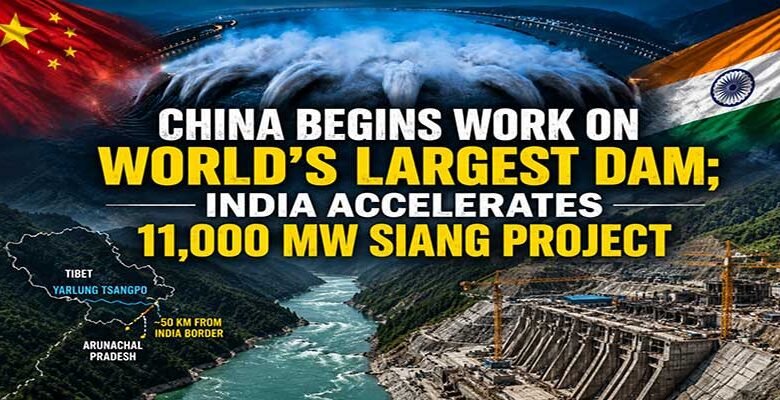
ITANAGAR/GUWAHATI: China has formally entered the construction phase of what is expected to become the world’s largest hydroelectric project on the lower reaches of the Yarlung Tsangpo River in Tibet, close to the Indian border in Arunachal Pradesh. The development has renewed concerns in India over water security, ecological stability and the strategic implications of large-scale infrastructure on a transboundary river system.
Known as the Medog (Motuo) Hydropower Project, the Chinese initiative is planned near the “Great Bend” of the Yarlung Tsangpo, barely 50 kilometres from the Line of Actual Control in Arunachal Pradesh. Once completed, the project is expected to generate around 60,000 MW of electricity—three times the installed capacity of China’s Three Gorges Dam—and produce nearly 300 billion kilowatt-hours of power annually. Construction officially began in July 2025, with commercial operations targeted around 2033.

The Yarlung Tsangpo flows into India as the Siang River before becoming the Brahmaputra in Assam, and finally entered in to Bangladesh. The river sustains millions of people through agriculture, fisheries, transportation and floodplain ecosystems.
India’s Strategic Response
In response, India has accelerated discussions around the proposed Siang Upper Multipurpose Project (SUMP) in Arunachal Pradesh. The 11,000 MW project, spearheaded by NHPC, is planned in Upper Siang and Siang districts and would become India’s largest hydropower project if implemented. Officials estimate that the project could generate nearly 47 billion units of electricity annually while also serving as a flood-control and water-regulation structure. The estimated project cost stands at approximately ₹1.5 lakh crore.
The Arunachal Pradesh government has increasingly described the project as a matter of national strategic importance. Chief Minister Pema Khandu has argued that the dam would not only generate electricity but also help regulate river flows and strengthen India’s ability to respond to upstream developments in Tibet.
Experts Divided Over Long-Term Consequences
Hydrologists and strategic analysts broadly agree that China’s dam is unlikely to “stop” the Brahmaputra’s flow entirely. However, concerns remain about China’s ability to regulate water discharge during critical periods, potentially influencing downstream water availability and flood patterns. Experts warn that abrupt releases of water during extreme weather events could increase flood risks in Arunachal Pradesh and Assam.
Environmental experts have raised additional concerns regarding the location of the Chinese project. The Great Bend region is one of the most biodiverse and geologically sensitive areas in the Himalayas, prone to earthquakes, landslides and extreme weather. Large-scale tunnelling and river diversion could alter river ecology and sediment transport patterns, with consequences extending downstream into India and Bangladesh.
While some political leaders have downplayed immediate concerns, scientists note that the long-term hydrological and ecological consequences of the project remain unclear due to limited publicly available technical data. Experts argue that changes in river flow, sediment transport and water-release patterns could have significant downstream implications for Arunachal Pradesh, Assam and Bangladesh.
Local Impact in Arunachal Pradesh
While concerns about China’s project focus largely on downstream impacts, the proposed Siang Upper Multipurpose Project has generated debate within Arunachal Pradesh itself.
Supporters argue that the project could transform the regional economy by generating revenue, creating employment opportunities, improving road connectivity and strengthening energy security. Proponents also believe it could serve as a strategic buffer against any future manipulation of river flows upstream.
However, local organisations, environmental groups and some political leaders have expressed apprehension about displacement, loss of agricultural land and the submergence of villages. Critics argue that thousands of indigenous residents could be affected if the project proceeds in its current form. Concerns have also been raised about cultural heritage sites, community forests and the long-term ecological health of the Siang valley. Arunachal Pradesh falls within one of the country’s most seismically active regions, adding another layer of complexity to the debate.
A New Geopolitical Frontier
The simultaneous emergence of the Medog Dam and the Siang Upper Multipurpose Project highlights how rivers are increasingly becoming part of broader strategic calculations between India and China.
For Beijing, the project represents a major source of renewable energy and regional development in Tibet. For New Delhi, it raises questions about water security, disaster preparedness and geopolitical leverage along a sensitive border region.
As both countries pursue ambitious hydropower projects on the same river system, experts say transparency, scientific cooperation and data-sharing mechanisms will become increasingly important to prevent environmental risks and geopolitical tensions from escalating.