From Architecture to Social Service: Techi Gubin Honoured with Padma Shri
For decades, Techi Gubin quietly worked behind the scenes — designing buildings, travelling to remote border villages, advocating for indigenous traditions and engaging in social service across Arunachal Pradesh.
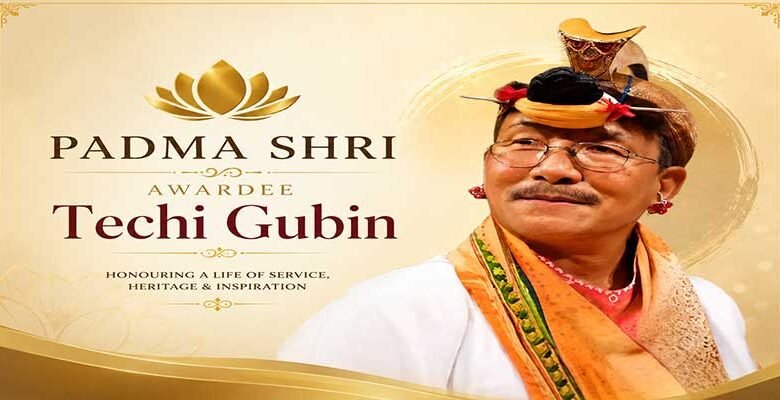
ITANAGAR- For decades, Techi Gubin quietly worked behind the scenes — designing buildings, travelling to remote border villages, advocating for indigenous traditions and engaging in social service across Arunachal Pradesh. This year, that long journey of public service has brought one of the country’s highest civilian honours to the retired architect and cultural activist.
On Monday, President Droupadi Murmu will confer the Padma Shri upon Gubin at Rashtrapati Bhavan in New Delhi. He is among 113 individuals selected this year for the prestigious award in recognition of contributions made in diverse fields.

For many in Arunachal Pradesh, however, Gubin’s identity extends beyond architecture or administration. Over the years, he has emerged as a familiar voice in discussions around border development, tribal welfare and preservation of indigenous faith systems in the Northeast.
Also Read- APLS East Siang Hosts Literary Open Mic ‘Shaam-e-Mehfil’ at Duman
Born on November 1, 1964, Gubin studied architecture at Chandigarh College of Architecture and graduated in 1988. His professional career began modestly as an assistant teacher before he joined the Arunachal Pradesh Public Works Department in 1990. Through nearly four decades of service, he worked across multiple government assignments and eventually retired as Chief Architect of APPWD.
His administrative career also included serving as Director of Housing and a deputation stint with HUDCO as Development Officer between 2000 and 2005.
Yet, colleagues and associates often describe his social involvement as equally significant as his government service.
Also Read- NCC CATC-19 Concludes Successfully in Tawang
Since 2000, Gubin remained actively associated with Arunachal Vikas Parishad (AVP), taking up different leadership responsibilities over the years — from assistant general secretary to president. Even after demitting office earlier this year, he continues to remain connected with several community initiatives in the region.
Currently, he serves as vice president of Akhil Bharatiya Vanvasi Kalyan Ashram, an organisation engaged in tribal welfare and rural development activities across the country.
One of the defining aspects of Gubin’s public life has been his involvement in preserving indigenous identity and traditional belief systems in Arunachal Pradesh. As president of the Nyishi Indigenous Faith and Cultural Society, he worked extensively for the promotion of the Donyi-Polo faith and cultural heritage.
Also Read- Anti-Drug Campaigner Gumin Mize’s Detention Sparks Calls for Judicial Inquiry
His outreach efforts also took him to some of the remotest frontier regions of the state. Through the Seemant Darshan Yatra organised in 2010 and later in 2021, Gubin travelled across villages located near the borders with China, Myanmar and Bhutan, interacting with local communities and assessing challenges related to infrastructure, connectivity and security.
Following these visits, delegations led by him reportedly met senior national leaders and submitted recommendations highlighting the strategic importance of Arunachal Pradesh’s border regions and the developmental concerns of local residents.
Apart from social work and public service, Gubin has also been associated with cultural and cinematic initiatives. He was linked with the regional film Oyaa, which received recognition as the best regional film in 2009.
Over the years, his contributions have earned several honours, including the O.N.E India Award in 2022 and the India Leader Award in 2023. The Padma Shri now adds national recognition to a career that blended architecture, administration, social activism and cultural preservation.
For many in Arunachal Pradesh, the honour is also being seen as recognition of the state’s indigenous identity, border communities and grassroots social initiatives that often remain outside the national spotlight.