Congress Launches Phase 1 of MGNREGA Bachao Sangram
The Delhi Congress organised one-day fasts and symbolic protests as part of a nationwide campaign opposing the Centre’s VB-GRAM-G Act, alleging it weakens MGNREGA’s rights-based framework.
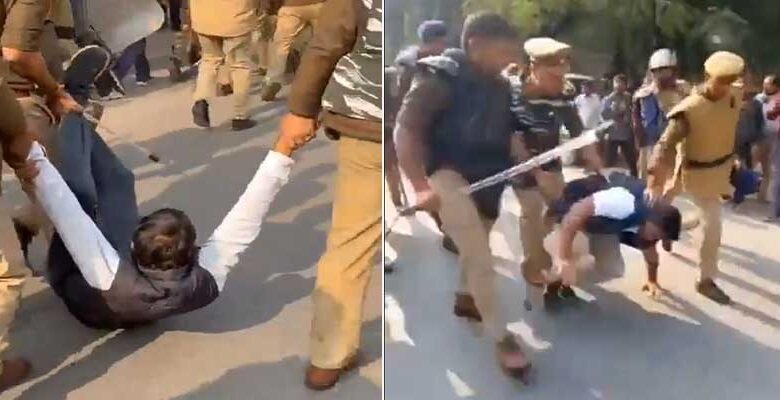
NEW DELHI- Delhi Congress leaders and workers on Sunday observed a one-day fast and held symbolic protests at district headquarters across the capital, marking Phase 1 of the party’s nationwide campaign titled MGNREGA Bachao Sangram.
The protests were held near statues of Mahatma Gandhi and BR Ambedkar, signalling the party’s attempt to frame the agitation as a defence of constitutional values and social justice.

The protests were directed against the central government’s Viksit Bharat—Guarantee for Rozgar and Ajeevika Mission (Gramin) or VB-GRAM-G Act, which the Congress alleges dilutes the Mahatma Gandhi National Rural Employment Guarantee Act (MGNREGA). Leaders from the Delhi Pradesh Congress Committee (DPCC) and District Congress Committees (DCCs), along with MGNREGA workers and activists, participated in dharnas and fasts across prominent locations in the city.
Also Read- Itanagar Corporator Calls on Arunachal Governor
The Congress has demanded the complete withdrawal of the VB-GRAM-G Act and restoration of MGNREGA as a rights-based law guaranteeing 100 days of employment, timely payment of wages, accountability mechanisms and the authority of Panchayati Raj institutions.
In a statement circulated during the protests, Congress general secretary Jairam Ramesh said the party was “committed to seeing this struggle through until we secure the restoration of the right to work, livelihood, and accountability that the Modi government has snatched.” Party leaders argued that the new legislation replaces a statutory entitlement with a centrally controlled “mission” lacking enforceable rights.
Also Read- Rare Saprophytic Mushroom Found in Longding
Congress leader KC Venugopal said the protests marked a shift towards a more decentralised and grassroots mobilisation, aimed at reaching villages and workers rather than remaining confined to the national capital. He said the campaign would expand steadily in the coming days.
Speakers at the Delhi protests criticised the VB-GRAM-G Act for removing Mahatma Gandhi’s name from the employment scheme, centralising financial and administrative control, weakening the role of state governments and local bodies, and undermining safeguards meant for rural workers, particularly women, Dalits and Adivasis.
Also Read- Doimukh Police Crack ₹3.5 Cr Burglary Case
Protesters carried placards reading “Restore MGNREGA,” “VB-GRAM-G = Dilution of Rights,” and “Save Rural Livelihoods,” while pamphlets were distributed outlining the perceived impact of the new law on nearly 10 crore workers who depend on MGNREGA annually. Senior DPCC leaders also indicated that the party was exploring legal remedies in addition to street-level mobilisation.
The Delhi protests coincided with similar one-day fasts and dharnas held at district headquarters across the country, in line with the campaign roadmap approved by the Congress Working Committee. While opposition allies have been invited to participate, the Congress has stated it will lead the agitation independently.
Phase 2 of the campaign is scheduled to begin on January 12, with panchayat-level meetings, mass outreach programmes and the delivery of letters from Congress president Mallikarjun Kharge and Leader of Opposition Rahul Gandhi to gram pradhans and rural workers, according to party sources.