Arunachal: Congress Slams Govt Plan to Replace MGNREGA with VB-G RAM G Bill
Congress accuses the Modi government of dismantling a rights-based rural employment law as Parliament witnesses protests over the VB-G RAM G Bill, 2025.
NEW DELHI- The Congress party on Monday intensified its opposition to the Narendra Modi government’s proposal to repeal the Mahatma Gandhi National Rural Employment Guarantee Act (MGNREGA) and replace it with the Viksit Bharat Guarantee for Rozgar and Ajeevika Mission (Gramin) (VB-G RAM G) Bill, 2025, describing the move as an attack on rural livelihoods and Gandhian principles.
Leader of the Opposition in the Lok Sabha, Rahul Gandhi, led the criticism, calling the proposed legislation a “direct insult” to Mahatma Gandhi’s vision of Gram Swaraj. In a post on social media platform X, Gandhi alleged that the government has consistently weakened MGNREGA over the past decade and is now attempting to dismantle it entirely. He described the scheme as a crucial safety net that supported millions of rural households, particularly during the COVID-19 pandemic.

Also Read- Centre Recognises YMCR’s River Cleanup Efforts
Gandhi argued that the new bill undermines three core features of MGNREGA: the legal right to demand employment, village-level autonomy in deciding development works, and full central funding of wages along with 75% of material costs. Under the proposed framework, he said, funding and decision-making would be centralised, states would be required to bear a higher share of costs, and employment could be curtailed once allocated funds are exhausted.
The VB-G RAM G Bill, introduced in the Lok Sabha by Union Rural Development Minister Shivraj Singh Chouhan amid opposition protests, proposes an increase in guaranteed employment from 100 to 125 days per rural household. It also seeks to prioritise the creation of durable assets such as water conservation structures and climate-resilient infrastructure, while shifting to a 60:40 Centre-state funding ratio for most states and 90:10 for northeastern and Himalayan states. The bill replaces the demand-driven nature of MGNREGA with a system of normative budget allocations.
Also Read- Himalayan University Wins Pride of Nation Award
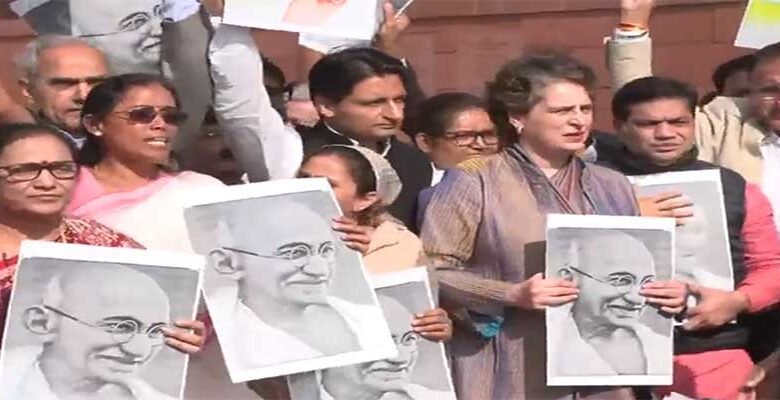
Congress leaders including Priyanka Gandhi Vadra and Shashi Tharoor protested in Parliament, accusing the government of erasing Mahatma Gandhi’s name and legacy from a landmark welfare law. Party president Mallikarjun Kharge described the move as a political attempt to dismantle a rights-based programme through what he termed an ideological agenda.
In response, the Congress announced nationwide protests on December 17 at district headquarters, followed by further mobilisation during the party’s Foundation Day on December 28. The party has said demonstrations will extend from Parliament to villages, framing the issue as a defence of constitutional and social justice principles.
Also Read- Congress Holds ‘Vote Chor, Gaddi Chhod’ Rally
Concerns have also been raised by some National Democratic Alliance partners, including the Telugu Desam Party, over the increased financial burden on states. The controversy has disrupted parliamentary proceedings, with the opposition demanding withdrawal of the bill and broader consultations.
Enacted in 2005 under the UPA government, MGNREGA remains one of India’s largest rural employment programmes. While the ruling party has cited inefficiencies and leakages to justify reforms, the debate has highlighted sharp ideological divisions over the future of welfare policy and rural employment guarantees.