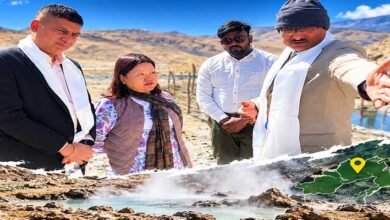
Arunachal Government Warns of Possible GLOF Risk Along Tawang Chu and Mago Chu Basins
The Arunachal Pradesh government has issued a high-alert advisory after scientists identified a potentially dangerous glacial lake near the Khangri Glacier in Tawang district.
TAWANG- The Arunachal Pradesh government has issued an urgent high-altitude public advisory following warnings of a possible Glacial Lake Outburst Flood (GLOF) originating from the Khangri Glacier region near the transboundary border with Tibet.
The advisory, issued by the Tawang district administration under the District Disaster Management Authority (DDMA), calls for heightened vigilance among residents, tourists, transport operators, and security personnel stationed across vulnerable high-altitude river basins.

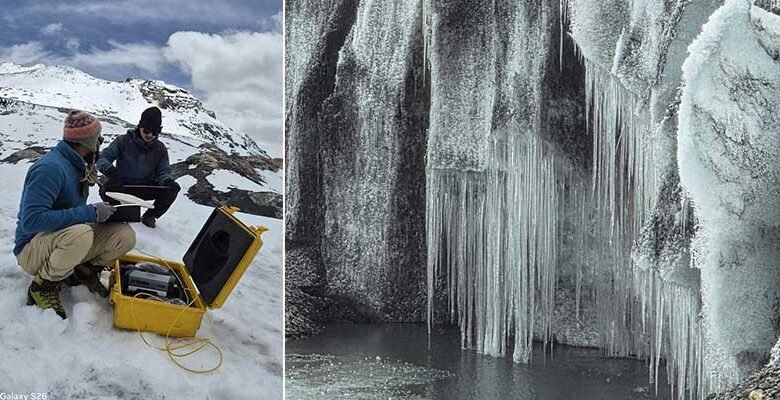
According to officials, the alert was triggered after a recent scientific assessment by the Centre for Earth Sciences and Himalayan Studies (CESHS), in collaboration with experts from the National Centre for Polar and Ocean Research (NCPOR) and the North Eastern Regional Institute of Science and Technology (NERIST). The findings emerged during the 5th Khangri Glacier Expedition.
Also Read- Scientists Warn of Rapid Changes in Khangri Glacier
Researchers identified a potentially unstable proglacial lake at an altitude of nearly 16,500 feet within the Mago Chu basin. Scientists also reported the existence of an active “Glacier Sinking Zone,” where sections of the glacier’s snout are collapsing due to rising temperatures and climatic shifts.
The expedition team warned that accumulated meltwater and unstable moraine debris behind fragile natural barriers could trigger a sudden lake breach, potentially affecting downstream settlements and river systems linked to the Brahmaputra basin.
In response, authorities have issued multiple safety directives. Residents and visitors have been advised to avoid riverbanks along the Tawang Chu and Mago Chu basins, suspend non-essential movement across high-altitude routes during heavy rainfall, and avoid crossing flooded streams or weakened bridges.
Also Read- Arunachal Pradesh to Conduct SIR of Electoral Rolls Under Phase-III
Tourists and commercial drivers have also been instructed to verify weather conditions and road clearances before travelling through mountain corridors. Local communities have been asked to monitor unusual environmental signs such as sudden drops in river levels, muddy water surges, or fresh ground fissures, which could indicate upstream blockage or glacial instability.
The warning comes amid growing concerns over glacial expansion and climate-linked hazards in the eastern Himalayas. According to recent satellite mapping by the Central Water Commission (CWC), Arunachal Pradesh currently has 197 expanding glacial lakes, the highest in India. The National Disaster Management Authority (NDMA) has identified 32 of these as high-risk lakes requiring active monitoring and mitigation.
Among the most vulnerable districts are Dibang Valley, Tawang, Anjaw, Shi Yomi, and Kurung Kumey, where glacial lakes pose threats to river valleys, hydropower infrastructure, border settlements, and local communities.
Also Read- Joint Team Destroys Wild Cannabis Spread Across 12 Acres in Pasighat
Officials said the state has intensified preparedness efforts following the October 2023 South Lhonak Lake disaster in Sikkim, which triggered devastating floods along the Teesta river system.
The Arunachal Pradesh State Disaster Management Authority (APSDMA) has recently conducted specialised training exercises using bathymetry survey equipment to assess lake depth and water volume. Teams from the India Meteorological Department (IMD) and Geological Survey of India (GSI) are expected to undertake detailed field mapping of high-risk lakes across the state.
Authorities are also preparing to install automated water-level recorders, satellite-linked early warning sirens, and high-altitude weather monitoring systems under the National GLOF Risk Mitigation Project, backed by an allocation of ₹45 crore.
During the Khangri Glacier expedition, scientists additionally installed five monitoring stakes equipped with Differential Global Positioning System (DGPS) technology at elevations of around 17,000 feet to monitor glacier movement and structural shifts.
District administrations, Village Disaster Management Authorities, and emergency response teams have been placed on round-the-clock alert to coordinate evacuation measures if abnormal water surges are detected.