Prof. Prakash Divakaran Highlights Sanskrit’s Relevance in AI and Modern Research
Speaking at an international conference in California, the Himalayan University Vice-Chancellor called for greater integration of Sanskrit knowledge traditions with contemporary science and technology.
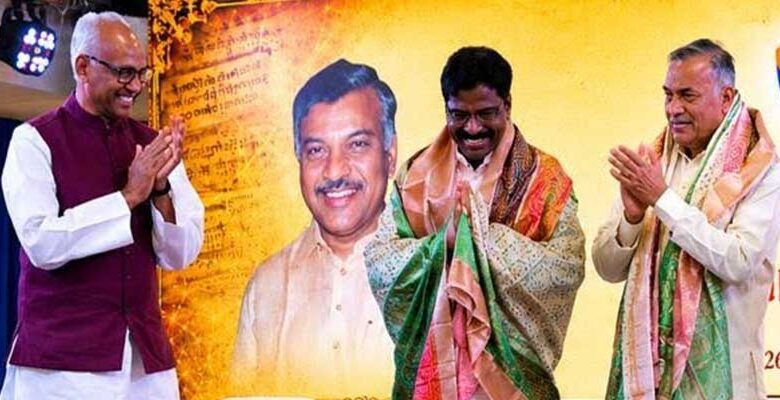
MILPITAS (California)- Prof. Dr. Prakash Divakaran, Vice-Chancellor of Himalayan University, Arunachal Pradesh, delivered the keynote address at the First Sanskrit Annual International Conference held in Milpitas, California, where he highlighted Sanskrit as a global knowledge system with contemporary relevance across multiple disciplines.
The conference, organised by Aria University in association with SYAAM, was conducted under the theme “Sanskrit as a Global Knowledge System: Integrating Ancient Wisdom with Modern Technology.” The event brought together scholars, academicians, researchers and Sanskrit enthusiasts from different countries to discuss the role of Sanskrit in education, technology, research and cultural preservation.

Addressing the gathering, Prof. Dr. Divakaran described Sanskrit as one of the world’s most structured and knowledge-rich languages. He noted that the language has contributed significantly to fields such as philosophy, mathematics, astronomy, medicine, linguistics and environmental studies, while continuing to offer valuable insights for contemporary academic research.
Also Read- Over 350 Participants Join Purple Fest Arunachal 2026 in Itanagar
In his keynote address, he argued that Sanskrit should be viewed not merely as a classical language but as a comprehensive repository of knowledge that has preserved intellectual traditions over centuries. He stressed the need to integrate traditional knowledge systems with modern technological advancements to address contemporary global challenges and support sustainable development.
Prof. Dr. Divakaran also highlighted the growing relevance of Sanskrit in emerging technological fields. He pointed to the language’s highly structured grammar and logical framework, suggesting that these characteristics make it particularly significant in areas such as artificial intelligence, natural language processing and computational linguistics.
Also Read- China Begins Work on World’s Largest Dam; India Accelerates 11,000 MW Siang Project
Calling for greater academic engagement, he urged universities and research institutions worldwide to promote interdisciplinary studies that connect ancient Indian knowledge traditions with modern scientific inquiry. Such collaborations, he said, could open new avenues for research and innovation while preserving valuable intellectual heritage.
The Vice-Chancellor also shared initiatives undertaken by Himalayan University to promote Indian Knowledge Systems (IKS), Sanskrit education and value-based learning. He emphasized the importance of international academic partnerships in advancing research on Sanskrit and indigenous knowledge traditions.
Also Read- Pasighat Hosts Jan Kalyan Shivir to Promote Natural Farming and Welfare Schemes
The conference featured several distinguished speakers, including Padma Bhushan awardee Dr. Yarlagadda Lakshmi Prasad, scholar Anand Kuchibhotla, and academician Prabhakar Kalavacherla, along with researchers and educators from various countries. Discussions during the event covered topics related to Sanskrit, technology, education, cultural heritage and future research opportunities.
Participants appreciated Prof. Dr. Divakaran’s address, particularly his emphasis on positioning Sanskrit as a knowledge resource capable of contributing to contemporary academic, scientific and technological developments.
The conference concluded with calls for stronger international collaboration in Sanskrit studies and a renewed commitment to exploring ways of integrating traditional knowledge with modern innovation for the benefit of society.