Tribal Knowledge Must Guide Education: Prof Riba
Scholars and educators discussed integrating indigenous knowledge into formal education during a national seminar at Arunachal Pradesh University in Pasighat.
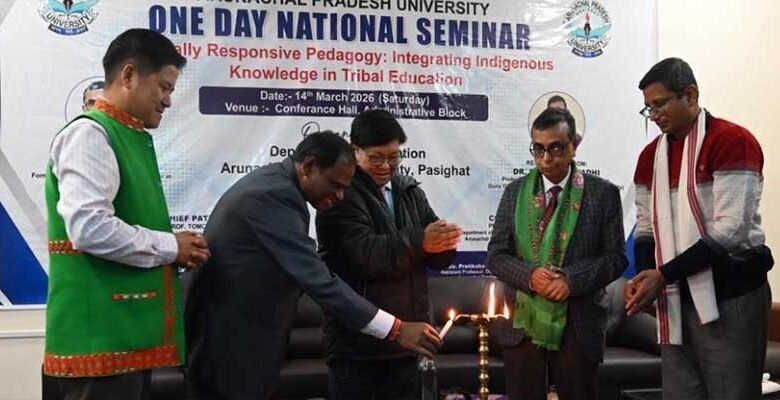
PASIGHAT- A national seminar on “Culturally Responsive Pedagogy: Integrating Indigenous Knowledge in Tribal Education” was held at Arunachal Pradesh University in Pasighat on March 14, bringing together scholars, educators, and researchers to discuss the role of indigenous knowledge systems in shaping inclusive education.
Delivering the keynote address as Chief Guest, Prof. Tomo Riba, founding and former Vice Chancellor of Arunachal Pradesh University, said that tribal communities are living repositories of knowledge whose wisdom is increasingly being recognised by the wider world.

“Our forefathers possessed immense knowledge that continues to guide society today,” Prof. Riba said, urging policymakers and educators to ensure that indigenous knowledge systems find a rightful place within formal education frameworks.
Also Read- Tourism Dept Trains Homestay Owners
He referred to traditional institutions such as Nyibu Nyegam Yarko and the Menjwk Meqkok Rwguu (MMR) Gurukul in Basar, noting that these institutions have long transmitted not just knowledge but values rooted in respect for nature, elders, and community responsibility. According to him, such indigenous institutions represent enduring models of education.
Prof. Riba also emphasised the importance of preserving native languages, expressing concern that younger generations are increasingly disconnected from the languages spoken by their ancestors. He urged communities to take pride in speaking and preserving their indigenous languages.
The keynote address was delivered by Prof. Amitava Mitra, former Pro Vice Chancellor of Rajiv Gandhi University, who spoke about the role of higher education in fostering economic growth in Arunachal Pradesh.
Also Read- National Lok Adalat Disposes 213 Cases in Arunachal
Reflecting on the transformation of the state’s education landscape, Prof. Mitra noted that Arunachal Pradesh has witnessed significant progress in expanding higher education institutions. However, he added that much potential remains untapped.
He said the state’s rich biodiversity, cultural diversity and strategic location offer unique opportunities for education and economic development. According to him, sectors such as eco-tourism, organic agriculture, traditional medicine and handicrafts could become major drivers of growth if supported by a culturally aware and skilled workforce.
Prof. Mitra also highlighted the issue of educated youth leaving the state in search of opportunities elsewhere, describing it as a challenge for long-term development.
Also Read- Simong Village Shows Strong Support for PFR Survey
Another resource person, Prof. Sambit Kumar Padhi of Guru Ghasidas Vishwavidyalaya, emphasised the importance of designing culturally relevant curricula before discussing teaching methods. He said education systems must consider students’ cultural and social backgrounds to ensure effective learning.
Prof. Padhi pointed out that tribal students often bring with them deep knowledge about their environment, traditions and communities, yet these experiences are rarely reflected in school curricula.
He also referred to the National Education Policy 2020, noting that its emphasis on mother-tongue-based multilingual education and recognition of local knowledge systems provides new opportunities to reform tribal education.
Earlier, in his welcome address, Dr. P. C. Jena, Head of the Department of Education and Dean of Academic Affairs at Arunachal Pradesh University, said the seminar aimed to address the long-standing exclusion of indigenous knowledge from formal education systems.
He observed that tribal communities possess knowledge systems that have sustained ecosystems and preserved cultural traditions across generations, yet these systems are often overlooked in mainstream curricula.
The seminar saw participation from several universities and institutions across the country, including Jamia Millia Islamia, Dibrugarh University, Utkal University and Patna University.
Approximately 38 research papers were presented across parallel technical sessions conducted in hybrid mode.
The sessions addressed themes such as culturally responsive teaching, revitalisation of indigenous languages, community participation in education, digital documentation of tribal languages and technology-enabled learning.
The seminar was co-convened by Dr. Kaling Moyong and Dr. Omini Ering, and attended by faculty members, researchers and students from various academic institutions.