Arunachal: Rare Yellow Puffball Mushroom Recorded in Longding
Researchers from ICAR-KVK Longding have documented a rare yellow puffball mushroom in Zedua village, potentially marking one of the earliest field records of the species in Longding district.
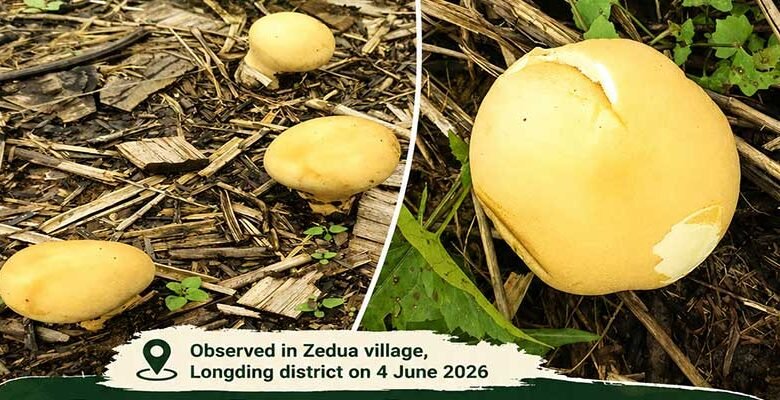
LONGDING– A team from ICAR-Krishi Vigyan Kendra (KVK), Longding has documented a distinctive yellow-coloured puffball mushroom during a field visit to Zedua village, a finding that may contribute significantly to the understanding of Arunachal Pradesh’s fungal biodiversity.
The mushroom was observed growing naturally on decaying woody debris and organic-rich soil during a field survey conducted on June 4. Based on its characteristic yellow globose fruiting body and puffball-like structure, the specimen was tentatively identified as Bovista colorata, commonly known as the Yellow Puffball Mushroom, by Dr. Deep Narayan Mishra, Subject Matter Specialist (Plant Pathology), ICAR-KVK Longding.

Researchers cautioned that detailed microscopic examination and molecular analysis are still required for definitive taxonomic confirmation. However, a review of available scientific literature suggests that documented records of the species from Longding district are currently lacking. If confirmed, the observation could represent one of the earliest recorded occurrences of Bovista colorata in the district.
Also Read- Dr. Byabang Rana, Tadar Kayu and Techi John Elected Unopposed to Lead AAPGA
Unlike conventional mushrooms that produce spores through gills beneath a cap, puffball fungi develop spores inside a closed spherical fruiting body. As the mushroom matures, the internal tissue transforms into a fine powdery mass of spores, which are dispersed through wind, raindrops or physical disturbance, allowing the species to spread over considerable distances.
Scientists note that puffball fungi play an important ecological role as decomposers. By breaking down plant residues and organic matter, they contribute to nutrient recycling, carbon cycling, soil health and the formation of organic matter within ecosystems.
Also Read- Poster-Making Competition Highlights Green Future Message in Arunachal’s Tuting
Several puffball species are also known for their nutritional value. Young specimens of certain species contain proteins, dietary fibre, essential amino acids and minerals. Research has additionally identified bioactive compounds with antimicrobial, antioxidant and anti-inflammatory properties, highlighting their potential relevance in pharmaceutical and biotechnology research.
Historically, puffball spores have been used in some traditional cultures as natural wound-dressing materials because of their moisture-absorbing and haemostatic characteristics. Experts, however, warn against consuming wild mushrooms without proper identification, as some poisonous species can resemble edible puffballs during early stages of development.
Also Read- Peaceful Shutdown Observed Across ICR During APIYO Bandh
The discovery highlights the largely unexplored fungal wealth of the Eastern Himalayan region and reinforces the need for systematic surveys, herbarium documentation, microscopic characterization and DNA barcoding of wild macrofungi.
Researchers believe that further scientific investigation could provide valuable insights into the ecological, agricultural, nutritional, medicinal and biotechnological significance of fungal species found in Arunachal Pradesh.
The field survey and documentation were carried out with the participation of Shri Vikas, SMS (Horticulture), and Dr. Amit Kumar, SMS (Land and Water Management Engineering), who supported the KVK Longding team during the visit.