Major Recruitment Reform in Arunachal: PRC, APST, Tribal Language Now Essential
Cabinet decision applies immediately to direct recruitment for Group A, B and C posts across government departments, PSUs, autonomous bodies and local bodies, amid sustained demands for stronger safeguards for indigenous communities.
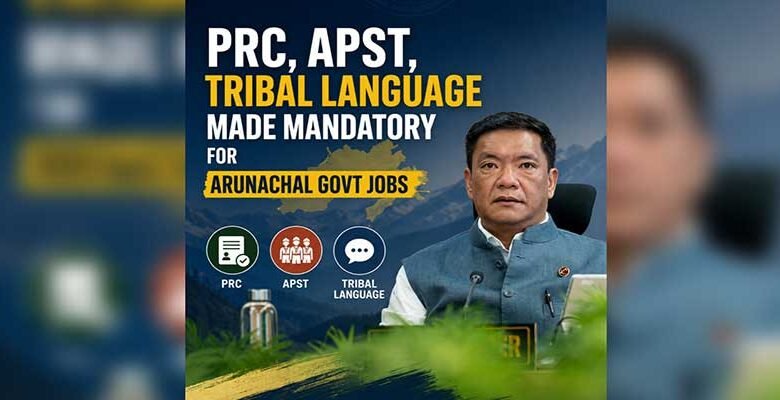
ITANAGAR- In a major change to government recruitment policy, the Arunachal Pradesh Cabinet chaired by Chief Minister Pema Khandu has approved uniform eligibility criteria for direct recruitment to all Group A, B and C services and posts in the state.
Under the new framework, candidates seeking direct recruitment will have to meet three mandatory conditions — possess a valid Permanent Residence Certificate (PRC), hold Arunachal Pradesh Scheduled Tribe (APST) status, and demonstrate proficiency in at least one Indigenous Tribal Language of Arunachal Pradesh from the notified list.

The provisions will take effect immediately and will apply to recruitment rules and service rules covering Group A, B and C posts and their equivalents. The scope extends beyond conventional state government departments to Public Sector Undertakings, autonomous bodies and local and urban bodies, among others.
Also Read- Ziro Royal Enfielders Extend Helping Hand to Deepak Nabam Living Home
The Cabinet has also directed the Arunachal Pradesh Public Service Commission (APPSC) and the Arunachal Pradesh Staff Selection Board (APSSB) to incorporate the new eligibility clauses in future recruitment advertisements and rules. A post-joining language test mechanism will also form part of the recruitment framework.
AAPSU had specifically pushed for PRC and APST verification
Employment became one of the most visible components of this wider debate.
In June, AAPSU submitted a 13-point memorandum to Chief Minister Pema Khandu seeking measures to safeguard the rights, identity and employment interests of indigenous communities.
Among its key employment-related demands was the abolition of the existing 80:20 recruitment ratio in APPSC and APSSB examinations, along with mandatory verification of PRC and APST certificates in government recruitment processes. AAPSU argued that employment opportunities intended for APST candidates should not be diluted through existing arrangements.
Also Read- DLSA East Siang Holds Legal Awareness Programme for APU Students
The issue remained active in July. The state government constituted a committee to examine the feasibility of abolishing the 80:20 ratio and to study making PRC and APST certificates mandatory for all competitive recruitment processes. The committee was also asked to examine the constitutional and legal aspects of the proposals and practices followed in neighbouring states.
AAPSU subsequently demanded that fresh APPSC and APSSB recruitment advertisements be kept on hold until the committee submitted its report, arguing that PRC and APST certification should become mandatory safeguards in recruitment.
The issue has remained politically charged. On August 10, AAPSU reportedly set an August 15 deadline for implementation of its demand relating to the 80:20 recruitment policy and threatened a 12-hour statewide bandh if the government failed to act.
Language becomes a new eligibility layer
The Cabinet’s August 13 decision now adds a new dimension to that debate.
While the earlier demands publicly documented by AAPSU focused particularly on PRC, APST certification and the 80:20 recruitment arrangement, the Cabinet has gone further by introducing Indigenous Tribal Language proficiency as a mandatory eligibility condition for direct recruitment.
The requirement applies across Group A, B and C recruitment and is not limited to a particular department or cadre. Candidates must be able to speak a language included in the government’s notified list of Indigenous Tribal Languages of Arunachal Pradesh.
The inclusion of a post-joining language test also suggests that language proficiency will not merely be a documentary requirement. APPSC and APSSB have been tasked with incorporating the mechanism into future recruitment rules and advertisements.
What changes for job aspirants?
For future direct recruitment, eligibility will now effectively involve three layers:
PRC → APST status → Indigenous Tribal Language proficiency
The immediate practical impact will be on candidates preparing for APPSC and APSSB examinations as well as recruitment conducted by other government-linked institutions covered by the decision.
The exact format, timing, assessment standard and implementation procedure of the language test will become important questions as APPSC and APSSB incorporate the new provisions into recruitment advertisements and rules.
For the state government, the policy represents a significant administrative response to the long-running debate over indigenous representation in government employment. For job aspirants, it changes the eligibility landscape for future recruitment and makes knowledge of an Indigenous Tribal Language a formal component of entry into the state’s government services.
The decision thus marks a shift from a debate largely centred on reservation ratios and certificate verification to a broader recruitment framework combining residency, indigenous status and linguistic proficiency.