Darak Heritage Trek Highlights Wildlife Conservation and Cultural Trails in West Siang
Organised by Along Forest Division and Darak Tourism and Social Welfare Foundation, the trek combined wildlife awareness, cultural heritage and eco-tourism, with plans to extend the route to Tobo Yobo Lake.
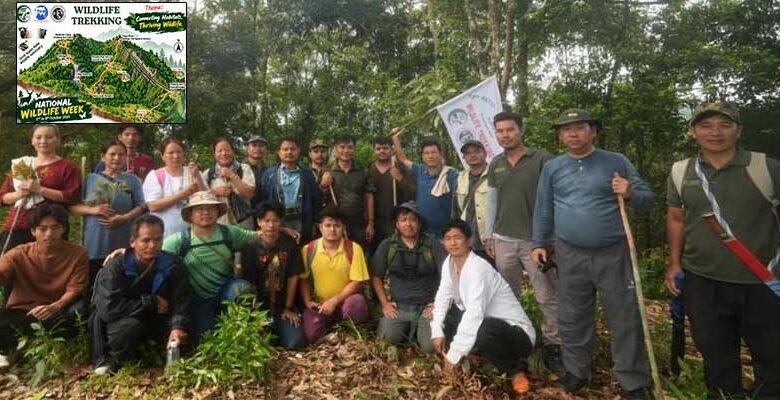
DARAK, WEST SIANG- A wildlife trekking programme organised at Darak during the 72nd National Wildlife Week has highlighted the potential of heritage trails, community participation and eco-tourism in supporting wildlife conservation in Arunachal Pradesh’s West Siang district.
The trek was organised by the Along Forest Division, Aalo, in collaboration with the Darak Tourism and Social Welfare Foundation (DTSWF), with participation from forest officials, NGO volunteers, members of the Darak Biodiversity Management Committee (BMC), Gaon Burahs and representatives of the Darak Mahila Samiti.

Held on October 6 under the Wildlife Week theme “Connecting Habitats, Thriving Wildlife,” the programme combined nature exploration with the rediscovery of old trails once used for inter-village connectivity, livelihoods and cultural exchange.
Also Read- APU Lecture Highlights Women’s Voices and Adivasi Experiences in Hindi Poetry
Heritage trails connect nature and history
The route was conceptualised by Jummo Potom, Managing Director of DTSWF, who rediscovered abandoned heritage trails and developed them into an eco-tourism activity.
Flagged off by Er. Gopin Padu, Divisional Forest Officer of Along Forest Division, from Sio near Poyom village, the trek passed through several locations of ecological and cultural significance.
These included Gense Satu, Dego Peak, Pegi Yorlo Eco-Camp-cum-Tea Garden in the community forest of Bogo village, Kebo Lipik Monolith and Ruku Waterfall near Larmuk Potom village. The trek concluded at Dimbesio Forest Camp within Yordi-Supse Rabe Wildlife Sanctuary, where an awareness programme on wildlife conservation was held.
At Dego Peak, participants observed remains associated with the migration history of the Mishing tribe, locally known as Mishing Dego Onam. Kebo Lipik Monolith was also highlighted as a shelter place linked to the community’s migration history towards the plains of Assam.
Also Read- Ziro Students Learn How to File RTI Applications at Awareness Programme
Conservation awareness and scientific documentation
Dr. Ranjit Daimary of the Botanical Survey of India, Itanagar, participated as a resource person. He encouraged participants to conserve local flora and fauna, document species scientifically, promote community-led conservation and maintain ecological balance.
Yide Potom, Assistant Conservator of Forests, highlighted the importance of wildlife trekking in developing a more empathetic relationship between people and nature.
Darak Circle Officer Mikri Riba documented the trek through videography and described the experience as an opportunity to understand wildlife beyond classroom learning. He also assured support for conservation initiatives through the Darak Biodiversity Management Committee and the preparation of a People’s Biodiversity Register under the Biological Diversity Act, 2002.
DFO Gopin Padu joined the participants throughout the trek and also motivated the Anti-Poaching Task Force stationed in Yordi-Supse Rabe Wildlife Sanctuary. Prizes were distributed to task force personnel in recognition of their services.
Also Read- 100 Archers, 13 Teams: Tawang Opens Five-Day State Archery Championship
Yordi-Supse Rabe Wildlife Sanctuary in focus
The press release describes Yordi-Supse Rabe Wildlife Sanctuary as the only wildlife sanctuary in West Siang district and the latest declared sanctuary in Arunachal Pradesh.
According to research cited in the release from the Zoological Survey of India, Itanagar, the sanctuary is home to species including Mishmi takin, locally known as Bembo, musk deer, snow leopard and red panda.
The trek provided participants with an opportunity to explore the sanctuary landscape while learning about the importance of protecting wildlife habitats and maintaining ecological balance.
Plans to extend trek to Tobo Yobo Lake
Jummo Potom said the 2026 programme was the third edition of the heritage trek, which he introduced in 2025 as an eco-tourism initiative to promote Darak.
Encouraged by positive feedback from participants, he expressed plans to extend the route to Sobo Yobo, also known as Tobo Yobo Lake. The proposed extension would explore areas described in the release as featuring tropical and alpine forests, grasslands and snow-capped mountains within Yordi-Supse Rabe Wildlife Sanctuary.
The foundation intends to promote the extended route as an eco-tourism opportunity while operating within the framework of the Wildlife (Protection) Act, 1972.
The programme demonstrated how rediscovered heritage trails can bring together cultural history, nature education and community-based conservation. Its future expansion could create further opportunities to promote Darak as a destination for responsible tourism while encouraging greater public participation in protecting the region’s natural heritage.