Arunachal Conservation Initiatives Featured at Global Mercury Pollution Conference in Hyderabad
Gumjum Haider highlights the Singchung Bugun Village Community Reserve and hornbill conservation around Pakke Tiger Reserve at the international conference hosted by IIT Hyderabad.
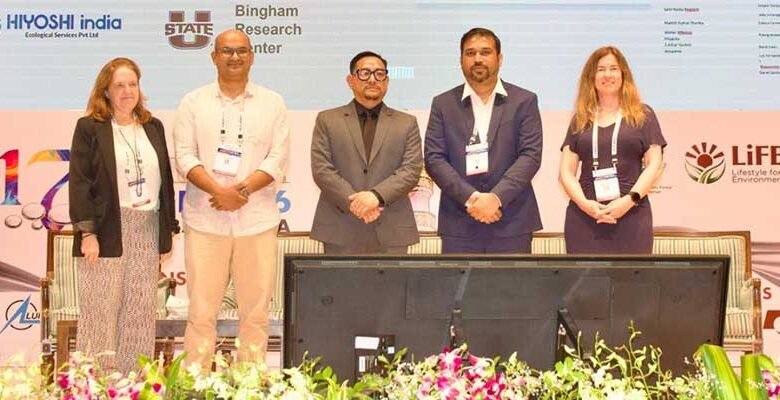
HYDERABAD- Community-led biodiversity conservation initiatives from Arunachal Pradesh received international attention at the 17th International Conference on Mercury as a Global Pollutant (ICMGP 2026), which concluded at the Indian Institute of Technology Hyderabad on Friday.
Gumjum Haider from Arunachal Pradesh presented examples of community-based conservation in the Eastern Himalayas, highlighting the Singchung Bugun Village Community Reserve and hornbill conservation initiatives in the landscape surrounding Pakke Tiger Reserve.

The six-day conference, held from October 4 to 9, brought together scientists, policymakers, environmental experts, representatives of international organisations and young researchers from 26 countries to discuss mercury pollution and its effects on human health and ecosystems.
Also Read- APU Lecture Highlights Women’s Voices and Adivasi Experiences in Hindi Poetry
Community-led conservation from Arunachal Pradesh
Haider’s presentation highlighted the role of Indigenous knowledge, local stewardship and community participation in protecting biodiversity.
The Singchung Bugun Village Community Reserve is a notable example of community-driven conservation, established through the efforts of the Bugun community to protect the habitat of the rare and endangered Bugun liocichla.
The presentation also discussed community engagement in hornbill conservation around Pakke Tiger Reserve, illustrating how local participation can complement scientific research and government conservation programmes.
Although the conference primarily focused on mercury pollution, the presentation brought a broader environmental perspective to the discussions by highlighting the importance of involving local communities in conservation planning and environmental decision-making.
The experiences from Arunachal Pradesh also underscored the value of combining scientific evidence with traditional knowledge and local responsibility to support long-term environmental protection.
Also Read- Ziro Students Learn How to File RTI Applications at Awareness Programme
International participation in science and policy discussions
ICMGP 2026 featured participation from major international environmental and public health institutions, including the Secretariat of the Minamata Convention on Mercury, the United Nations Environment Programme (UNEP) and the World Health Organization (WHO).
According to the conference report, WHO’s participation in its official capacity marked a first in the conference’s history.
Monika Stankiewicz, Executive Secretary of the Minamata Convention on Mercury, engaged with the scientific community on the relationship between research and international environmental governance. Eisaku Toda of the Convention Secretariat also contributed to scientific and policy discussions.
Representatives from Minamata, Japan, including a person affected by Minamata disease, shared perspectives that highlighted the long-term human consequences of mercury pollution.
The conference also involved scientific journal editors, including Rob Mason, Patricia Forbes, Bryan Brooks and Greg Lowry, alongside representatives of scientific publishers and instrument manufacturers.
Also Read- 100 Archers, 13 Teams: Tawang Opens Five-Day State Archery Championship
From scientific research to practical action
During the valedictory programme, conference chairs Dr Jagannath Biswakarma of the University of Bristol and Professor Asif Qureshi of IIT Hyderabad reflected on the importance of international scientific cooperation and the need to translate research findings into practical environmental solutions.
Discussions emphasised that scientific conferences must contribute beyond academic publications, supporting improvements in environmental governance, public health protection and ecosystem management.
The participation of students and early-career researchers was also recognised as important for building future scientific and policy expertise.
Significance for Northeast India
Haider’s contribution brought visibility to conservation initiatives from Arunachal Pradesh at an international gathering focused on environmental challenges.
The Bugun community’s efforts to protect the Bugun liocichla and conservation activities around Pakke Tiger Reserve illustrate how community engagement can contribute to biodiversity protection.
While mercury pollution and biodiversity conservation involve different scientific challenges, both require credible evidence, institutional cooperation and meaningful participation by affected communities.
The conference concluded with an emphasis on international collaboration, scientific capacity building and the translation of research into action to protect human health and the environment.