Arunachal: Disaster Training for RGU Students at NDRF Campus
Students from Rajiv Gandhi University receive practical disaster response training at 12th Battalion NDRF in Itanagar.
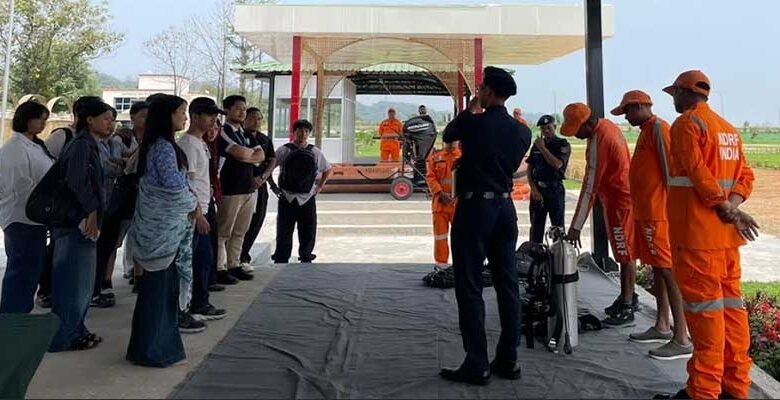
ITANAGAR- A group of 20 students from the Diploma in Disaster Management programme at Rajiv Gandhi University (RGU) participated in a hands-on training session at the 12th Battalion of the National Disaster Response Force (NDRF), aimed at strengthening practical skills in disaster response and emergency management.
The students, drawn from the Department of Geography and the Department of Agricultural Extension and Communication under the Faculty of Agricultural Sciences, were accompanied by faculty members Prof. S. Saikia, Dr. Khaidem Nirja, and Azhanuo Rutsa.

The training programme included both classroom sessions and field-based demonstrations conducted by NDRF personnel. Officials introduced participants to a range of advanced tools and techniques used in disaster situations, emphasising preparedness and operational efficiency.
Also Read- NCC Cadets Trek Historic Baileys Trail in West Kameng
Students were given practical exposure to specialised equipment such as chemical and radiation detectors, along with personal radiation detection devices used in hazardous environments. Training also covered the use of personal protective equipment (PPE), casualty evacuation tools, and safety protocols critical during emergencies.
A significant component of the programme focused on flood rescue and deep-water operations. Participants were introduced to scuba gear, inflatable rescue boats, and water safety equipment, which are integral to NDRF-led rescue missions during floods.
Also Read- East Kameng Marks Panchayat Day with Grand Event
The session further familiarised students with technical rescue tools, including hydraulic cutters, combination spreaders, air lifting bags, and rock-climbing gear used in search-and-rescue operations in collapsed structures. Demonstrations of cutting tools and life detection devices—used to locate victims trapped under debris—were also conducted.
Officials highlighted that such equipment forms part of NDRF’s specialised capabilities in responding to chemical, biological, radiological, and structural emergencies.
The interactive nature of the training enabled students to gain first-hand experience of disaster response scenarios, reinforcing the importance of coordination, preparedness, and timely intervention. The initiative aimed to bridge the gap between academic learning and real-world application while encouraging students to contribute to disaster-resilient communities.