Arunachal CM Announces Creative Economy Programme, ‘Mini NITI Aayog’ for State
At the APEDP Cohort 4 graduation and Cohort 5 launch, Chief Minister Pema Khandu announced the Arunachal Creative Economy programme and the Institute for Transforming Arunachal, while unveiling new measures to strengthen entrepreneurship, incubation and investment.
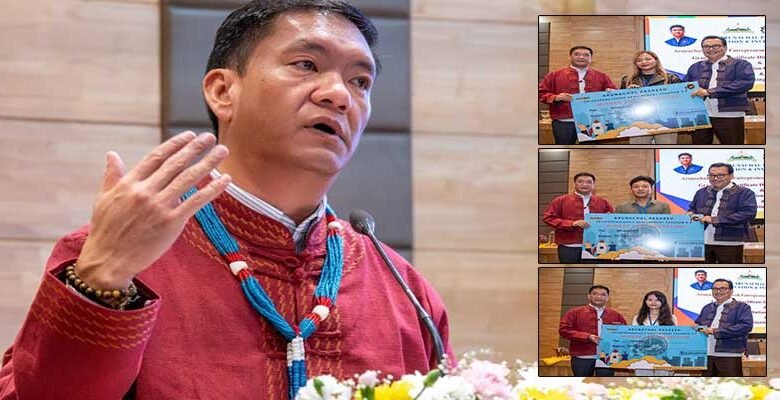
ITANAGAR: Arunachal Pradesh Chief Minister Pema Khandu on Tuesday announced a series of initiatives to strengthen the state’s startup ecosystem, promote creative enterprises and attract investment, including a proposed Arunachal Creative Economy (ACE) programme and an expert think tank called the Institute for Transforming Arunachal (ITA).
Khandu described ITA as a “mini NITI Aayog” for the state, envisaging a platform where subject experts would help guide policy development in sectors such as agriculture, allied activities and tourism.

The announcements were made during a programme marking the graduation of Cohort 4 and the commencement of Cohort 5 of the Arunachal Pradesh Entrepreneurship Development Program (APEDP). The event also featured the inauguration of satellite incubation cells at seven higher education institutions and the signing of memoranda of understanding (MoUs) with five additional institutions.
Deputy Chief Minister Chowna Mein, the Chief Secretary, the Planning and Investment Commissioner, Arunachal Pradesh Innovation and Investment Park (APIIP) CEO Tabe Haider, officials, a representative of NITI Aayog and young entrepreneurs attended the programme.
Also Read- Itanagar: NH-415 Package-B Delay Sparks Public Rally, PRAC Seeks Deadline
New initiatives to expand entrepreneurship
The proposed ACE programme, Khandu said, would provide young people with creative ideas a platform to develop them into viable businesses. The initiative is intended to support the growth of creative enterprises and expand opportunities for young entrepreneurs.
The proposed ITA, meanwhile, would bring together experts to provide guidance on policy and development priorities across key sectors.
Khandu also said he was in contact with venture capitalists and planned to convene a conference where startups from Arunachal Pradesh could present their business ideas to potential investors.
To support businesses graduating from the startup programme, the Chief Minister directed the Planning and Investment Department and the APEDP cell to consult the Department for Promotion of Industry and Internal Trade (DPIIT) on possible state incentives. These could include income-tax-related support for startups transitioning from proprietorships to private limited companies or limited liability partnerships (LLPs). A policy decision was expected in the coming days, according to the announcement.
Also Read- Rahul Gandhi Claims 200 ED, CBI and MEA Officials Are in Touch With Opposition
Startup intake and seed funding increased
Started in 2021 during the COVID-19 pandemic, APEDP has helped launch more than 150 startups, Khandu said.
The programme’s intake has been increased from 50 to 100 startups. Seed funding has also been raised, with the announced support levels increasing from ₹5 lakh to ₹10 lakh and from ₹4 lakh to ₹8 lakh.
Around 100 entrepreneurs in Cohort 5 are expected to undergo a nine-month incubation programme at APIIP, receiving mentorship from reputed institutions, including the Indian Institute of Management (IIM).
The Chief Minister also cited Arunachal Pradesh’s performance in the National Startup Ranking Framework, stating that the state was among the top three states recognised on the occasion of 10 years of Startup India and the only state from the Northeast to receive that recognition.
Seven institutions get incubation cells
Satellite incubation cells were inaugurated virtually at seven institutions that had signed MoUs with the programme in the previous year. These are:
- Rajiv Gandhi University
- Arunachal Pradesh University, Pasighat
- Arunachal University of Studies, Namsai
- National Institute of Technology, Jote
- NEDIS, Nirjuli
- Dera Natung Government College, Itanagar
- Dorjee Khandu Government College, Tawang
MoUs were also signed with five additional institutions to expand the programme’s reach:
- Donyi Polo Government College, Kamki
- Government College, Bomdila
- Indira Gandhi Government College, Tezu
- Government Model College, Seppa
- St. Claret College, Ziro
The expanded network is intended to make incubation and entrepreneurship support more accessible to students and aspiring business owners across the state.
Also Read- Opposition Takes ‘March for Democracy’ to Supreme Court Over Alleged Vote Chori
YES Arunachal portal launched
Khandu also launched the YES (Youth Empowerment Sphere) Arunachal portal, a single-window platform hosted on APIIP to provide information on Central and state government schemes.
He encouraged young people to participate in the National Innovation Challenge under the Sewa Sankalp Abhiyan and thanked NITI Aayog for establishing Atal Tinkering Labs in schools across the state.
The Chief Minister also asked the Chief Secretary to organise workshops for APEDP alumni, focusing on the use of digital platforms to reach national and international markets. He directed the APIIP CEO to expedite the organisation’s conversion into a Section 8 company, a move he had approved after announcing it at the previous year’s programme.
Startups encouraged to explore new markets
Highlighting the potential of the Micro, Small and Medium Enterprises (MSME) sector, Khandu encouraged entrepreneurs to explore business opportunities in the segment. He noted that banking networks could help entrepreneurs access capital and, where required, land.
He referred to Central and state support schemes, including the UNNATI scheme for the Northeast, Deen Dayal Upadhyaya Swavalamban Yojana, Chief Minister Paryatan Vikas Yojana and the state’s Atmanirbhar schemes for agriculture, horticulture and fisheries.
Khandu also highlighted successful APEDP alumni as examples of the range of businesses emerging from the programme.
Also Read- Tawang Admin Promotes Community-Based Tourism in Jang–Mago–Chuna Corridor
These included Arunachal Ivory and Ornaments, which developed 3D-printed replicas of traditional animal headgear and was featured in the Prime Minister’s 113th Mann Ki Baat. The enterprise received a ₹10 lakh grant under the AIC-SMUTBI Digi Sapne Programme.
Other examples cited were KT Marketing of Ziro, winner of the Bharat Entrepreneur Award 2025; Popil Tunes, selected for the STPI Octane Programme 2025 under the Ministry of Electronics and Information Technology; House of Macnok of Pasighat, selected for a Global Entrepreneurship Consulting Project with the University of Oklahoma in the United States; CK Bliss Health & Rhythm, which received a Governor’s Appreciation Letter; and Mete Foods and Slot Allot, included in the North Eastern Council’s top 50 incubation list.
Investment prospects and economic growth
Addressing the state’s broader economic prospects, Khandu said hydropower projects with a combined capacity of 19,000 MW were at various stages of development. He also referred to five mineral blocks, including graphite and vanadium, that had been auctioned in collaboration with the Union Ministry of Coal and Mines.
With further mineral blocks expected to follow and rare-earth deposits to be explored, the Chief Minister said Arunachal Pradesh had the potential to improve its fiscal position and create more resources for public welfare.
Under the Rising North East Investment Summit, five investments worth ₹809 crore had reached the implementation stage, while proposed investments totalling ₹7,941 crore were being pursued, according to the figures cited at the programme.
Khandu appealed to local communities to support investors and help establish Arunachal Pradesh as an investor-friendly destination.
Women-led development and rural livelihoods
The Chief Minister credited women-led development and the self-help group movement with contributing to the state’s progress, noting that around 1.5 lakh women were actively involved in the movement.
He called for a stronger rural economy as a foundation for the vision of a developed Arunachal Pradesh by 2047.
Khandu also urged entrepreneurs to improve their understanding of government policies, company law, the Arunachal Pradesh State Industrial and Investment Policy and the new labour laws.
Emphasising the importance of financial discipline, he identified bookkeeping as an area requiring greater attention among local entrepreneurs. He advised businesses to engage chartered accountants, maintain annual balance sheets and file income-tax returns even when no tax was payable.
He further encouraged entrepreneurs to build on the state’s 20 Geographical Indication (GI) tags through value addition and digital marketing.
Focus on scaling businesses
Congratulating Cohort 4 graduates and welcoming the new cohort, Khandu assured entrepreneurs that his doors remained open to them. He acknowledged the contributions of Deputy Chief Minister Chowna Mein, the Commissioner, APIIP CEO Tabe Haider and the APIIP team.
The announcements signal the state’s effort to connect entrepreneurship training with incubation, market access, investment and policy support. The effectiveness of the new initiatives will depend on their implementation, the availability of sustained support for startups and the ability of local enterprises to expand beyond the state.