Arunachal: Forest Staff Trained to Protect India’s Only Ape
Aaranyak, in collaboration with forest authorities, organised a specialised training in Namsai to strengthen conservation efforts for the endangered Western Hoolock Gibbon.
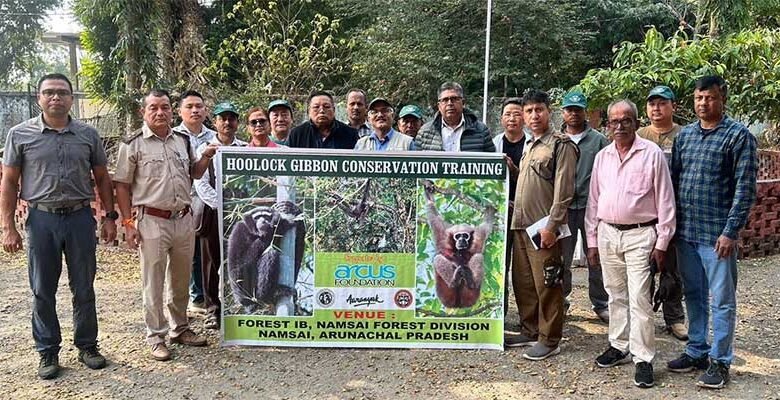
NAMSAI- A conservation training programme focused on protecting the endangered Western Hoolock Gibbon, India’s only ape species, was organised at the headquarters of the Namsai Forest Division in Namsai, Arunachal Pradesh, on February 23, 2026. The initiative was led by Aaranyak in collaboration with Namdapha National Park & Tiger Reserve authorities, with support from the Arcus Foundation.
The training aimed to familiarise forest personnel with the ecology, conservation challenges and monitoring methods related to the Western Hoolock Gibbon (Hoolock hoolock), an endangered primate found primarily across northeastern India.

Experts noted that the Namsai Forest Division represents a potential habitat for the species, making capacity-building efforts among frontline staff particularly significant. Organisers described the workshop as the first of its kind in both Namsai district and the forest division.
Also Read- Gaon Burahs Take Wildlife Protection Pledge in Sangram
The programme was inaugurated by Divisional Forest Officer Tabang Jamoh, who emphasised the collective responsibility of stakeholders to protect the species, which is also the state animal of Arunachal Pradesh. He encouraged forest staff to develop practical expertise in Global Positioning System (GPS) and Geographic Information System (GIS) technologies to improve wildlife monitoring and conservation planning.
Dr. Dilip Chetry, senior primatologist and head of Aaranyak’s Primate Research and Conservation Division, led the first technical session. He outlined the current conservation status of the Western Hoolock Gibbon, highlighting threats such as habitat loss and fragmentation, while advocating for its recognition as a flagship species for biodiversity conservation in the region. An interactive session coordinated by Range Officer Alok Kumar further explored practical challenges faced by field staff.
Also Read- Governor Attends Pran Pratishtha, Meets Youth Delegations
The second session, led by Arup Kumar Das, focused on the application of geo-spatial technologies in wildlife research. Participants received hands-on training in GPS-based field techniques, including recording waypoints, tracking routes and assessing proximity, with practical demonstrations supported by conservation specialists.
Twenty forest personnel from six ranges under the Namsai Forest Division — Namsai, Manabhum, Tengapani, Chowkham, Medo and Wakro — attended the training. The programme concluded with the distribution of digital study materials and conservation posters, reinforcing ongoing efforts to build local capacity for primate protection.
Observers note that such targeted training programmes are increasingly being viewed as essential for safeguarding endangered species in the Eastern Himalayan landscape, where community engagement and technical skills among forest staff play a crucial role in long-term conservation outcomes.