Pema Khandu Highlights Arunachal Growth Story at ICPP Growth Conference
At ICPP Growth Conference 2026, CM Pema Khandu outlines reforms, hydropower potential, and Arunachal’s development roadmap.
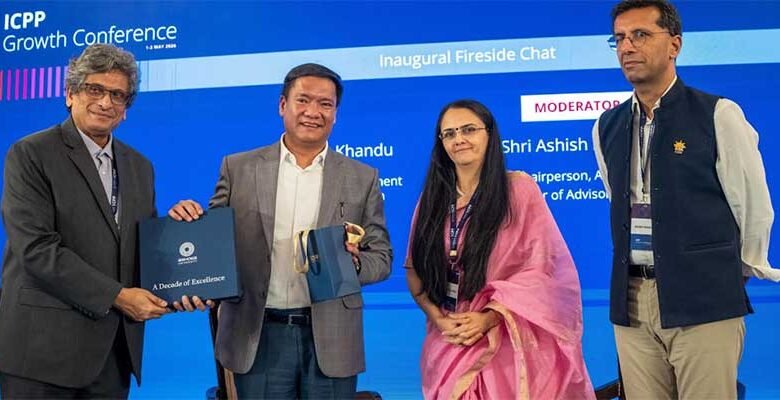
NEW DELHI- Pema Khandu on Thursday highlighted Arunachal Pradesh’s growth trajectory and future potential while addressing the ICPP Growth Conference 2026 held at the Taj Mahal Hotel in New Delhi.
The conference, hosted by the Isaac Centre for Public Policy (ICPP), brought together policymakers, academicians, and experts to discuss public policy and inclusive development.

Khandu described Arunachal Pradesh as strategically significant and culturally diverse, tracing its journey from the North-East Frontier Agency (NEFA) to Union Territory status in 1972 and full statehood in 1987. He noted that the state is home to 26 major tribes and over a hundred sub-tribes, with Hindi serving as a unifying language.
Also Read- Arunachal Scholar Showcases Tani Mental Health Models at NAOP conference
Growth and Transformation
The Chief Minister said the Northeast region has undergone a major transformation over the past decade, moving beyond earlier perceptions of insurgency and underdevelopment. He credited leadership at the national level and increased engagement by Union Ministers for accelerating development in the region.
Highlighting economic potential, Khandu described Arunachal Pradesh as a “powerhouse of India” in hydropower, noting that projects with a capacity of around 19,000 MW are underway, with a long-term target of 40,000 MW by 2047.
Also Read- Christians Demand Repeal of APFRA 1978
He also pointed to growth in tourism, agriculture, and horticulture, supported by improved infrastructure and connectivity, especially in remote and border areas.
Governance and Reforms
Khandu emphasized governance reforms aimed at transparency, including the establishment of a robust Staff Selection Board and reforms in the Public Service Commission to ensure merit-based recruitment.
In education, he highlighted efforts aligned with the National Education Policy 2020, including rationalisation of non-viable schools and a focus on improving quality. Expansion of higher education and healthcare infrastructure, including new medical colleges, was also noted.
Sustainability and Outreach
The Chief Minister underlined Arunachal Pradesh’s commitment to environmental sustainability, referencing structured strategies aligned with national climate commitments.
He also spoke about grassroots initiatives such as “Seva Aapke Dwar” and “Sarkar Aapke Dwar,” aimed at delivering government services directly to remote communities, strengthening public trust and last-mile connectivity.
Looking Ahead
Khandu reiterated that sustained reforms, infrastructure development, and investment in people are central to Arunachal Pradesh’s long-term growth.
“When we invest in people and create opportunities, we move forward together,” he said.
The conference served as a platform for dialogue on public policy, education, and inclusive growth, bringing together diverse perspectives from across the country.