Arunachal: Khandu Leads First-of-its-Kind River Journey on Subansiri
Chief Minister Pema Khandu undertakes a 45-km river journey on the Subansiri, linking hydropower expansion with tourism and regional development.
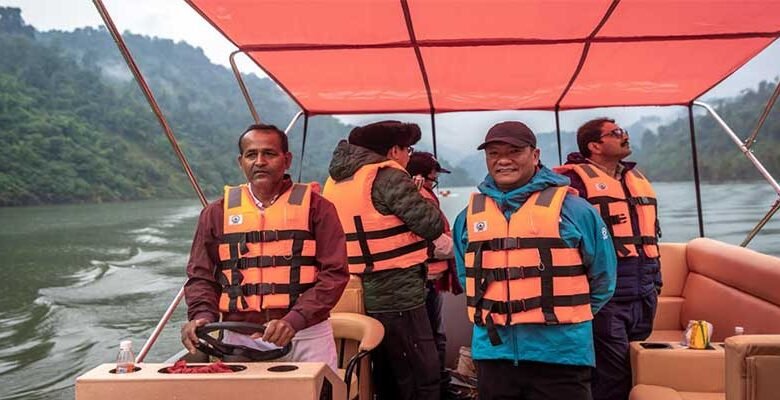
DOLLUNGMUKH- In what was described as a significant symbolic and developmental milestone, Arunachal Pradesh Chief Minister Pema Khandu undertook a high-speed river journey spanning approximately 45 kilometres along the Subansiri river, from the Subansiri Lower Hydroelectric Project site at Dollungmukh to the Sibe-Rite confluence.
The journey, conducted alongside senior officials and public representatives, is being positioned as part of a broader effort to integrate hydropower development with tourism potential in the State. Addressing a gathering, Khandu termed the event “history in the making,” noting that such an expedition had not previously been undertaken in Arunachal Pradesh.

The Chief Minister linked the initiative to the larger developmental framework aligned with the Government of India’s “Viksit Bharat” vision, alongside the State’s own roadmap for economic growth. He emphasised the need to convert Arunachal Pradesh’s natural resources into sustainable sources of revenue through structured policy interventions.
Also Read- Massive Fire Hits Lakshmi Narayan Mahayagna In Ayodhya; No Casualties Reported
The Subansiri Lower Hydroelectric Project, developed by National Hydroelectric Power Corporation, was highlighted as a key component of this strategy. Initiated in 2001, the project has faced delays due to local opposition but has regained pace in recent years. Officials indicated that by December 2026, the project is expected to generate 2,000 MW of power, making it one of the largest hydroelectric installations in the country.
Beyond this, hydropower projects with a combined capacity of nearly 19,000–20,000 MW are currently in various stages of development across Arunachal Pradesh. Khandu acknowledged the support of local communities in districts such as Kamle, Lower Siang, and Upper Subansiri, describing their cooperation as critical to advancing large-scale infrastructure initiatives.
Also Read- DC Inspects New JNV School at Taliha
He also pointed to the Subansiri project’s extended reservoir stretch, which spans nearly 45 kilometres, describing it as the longest of its kind in the country. The proposed Upper Siang Multipurpose Project could potentially surpass this in scale.
Alongside energy generation, the Chief Minister emphasised the tourism potential of the region. He described Arunachal Pradesh’s rivers, forests, and biodiversity as assets capable of attracting both domestic and international visitors. Plans are being considered for eco-friendly tourism infrastructure, including water sports, high-speed yachts, and hospitality ventures.
Also Read- APSSB Announces 984 Vacancies for Uniformed Services in Arunachal Pradesh
Khandu stated that the government intends to undertake a comprehensive survey and prepare a master plan for sustainable tourism development, with consultations involving local stakeholders and consideration of land classifications such as community lands and reserve forests.
Officials also indicated that improved accessibility and targeted promotion could position the region as a destination for filmmakers and content creators, potentially expanding its visibility beyond conventional tourism circuits.
Describing hydropower as a relatively clean source of energy, Khandu underlined its importance in ensuring energy security amid global uncertainties in conventional energy markets. He called for coordinated efforts among government agencies, local communities, and stakeholders to ensure that development remains both inclusive and sustainable.
The Chief Minister was accompanied by Deputy Chief Minister Chowna Mein, Deputy Speaker Kardo Nyigyor, Hydropower Advisor Ninong Ering, and senior administrative officials led by the Chief Secretary.
The event, while largely symbolic, signals a policy direction that seeks to combine infrastructure expansion with tourism-led economic diversification in Arunachal Pradesh.