SUMP Protests Reach Delhi: Hundreds Gherao Arunachal Bhawan, Demand Release of Detainees
Organised by Himkhand and Youth for Change, the demonstration demanded withdrawal of the proposed mega project, release of detainees and removal of security forces from the Siang region.
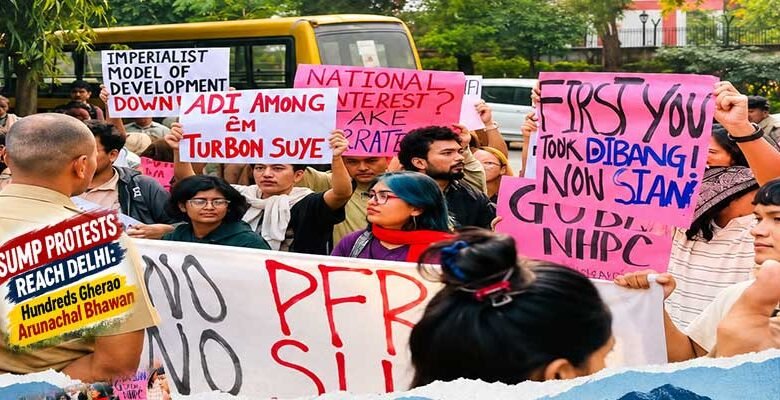
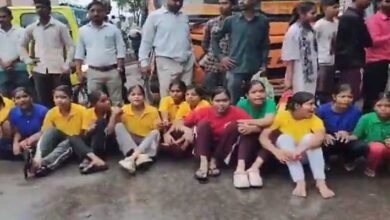
NEW DELHI- The opposition to the proposed 11,200 MW Siang Upper Multipurpose Project (SUMP) in Arunachal Pradesh reached the national capital on Saturday, as hundreds of students and activists gheraoed Arunachal Bhawan in New Delhi, demanding withdrawal of the project and the release of people detained during the ongoing protests in the Siang region.
The demonstration was organised under the banners of Himkhand and Youth for Change. Protesters raised anti-dam slogans and demanded the unconditional release of all detainees, withdrawal of the proposed project and removal of Central Armed Police Forces (CAPF) deployed in the Siang region.

Delhi Police detained several demonstrators during the protest. Among those taken into custody was prominent Siang hydropower activist and environmental engineer Katon Moyong, popularly known as Aborman, who was reportedly detained while interacting with the media. A heavy police presence was deployed outside Arunachal Bhawan.
The demonstration brought the ongoing opposition to SUMP beyond Arunachal Pradesh, drawing attention to the concerns of indigenous communities over the proposed project and the recent security and law-and-order developments in the State.
Also Read- Guwahati Protesters Extend Solidarity to Arunachal Communities Opposing SUMP
Opposition to SUMP Intensifies
The Siang Upper Multipurpose Project is a proposed large hydropower and multipurpose storage project being pursued by the Centre through NHPC. The project has been discussed for nearly two decades and has been positioned by the government in the context of India’s strategic, water-security and flood-management concerns, particularly in view of China’s proposed large hydropower development on the upstream Yarlung Tsangpo in Tibet.
However, indigenous Adi and Galo communities, along with organisations including the Siang Indigenous Farmers’ Forum (SIFF), Adi Bane Kebang United and youth groups, have opposed the project for years.
Their concerns include possible submergence of ancestral villages and land, displacement of communities, loss of agricultural areas and cultural sites, ecological damage in a seismically active Himalayan region, and threats to livelihoods associated with the Siang River.
For many communities, the river, traditionally revered as “Ane Siang” or Mother Siang, holds deep cultural and historical significance.
Also Read- Itanagar Rally Backs Siang Anti-Dam Movement, Demands Release of Detained Protesters
Recent Protests and Security Deployment
Opposition to the project intensified following the 12-hour bandh on October 23 across Siang, Upper Siang and East Siang districts. The protest turned violent in Pasighat, with reports of arson at an NHPC office and a police station, damage to vehicles and vandalism at the residences of political leaders, including MLAs and the State BJP president.
Police used tear gas to disperse protesters, while dozens of people were arrested or detained in connection with the incidents. Reports have cited figures ranging from around 60 to 70 in related cases.
The State also witnessed a significant security deployment, with reports of more than 30 companies of CAPF personnel being deployed in the region near proposed survey and drilling locations to facilitate the preparation of the project’s Pre-Feasibility Report (PFR).
Solidarity demonstrations were subsequently held in Itanagar on October 29, followed by Saturday’s protest in New Delhi.
Also Read- Siang Par Sangram: Understanding the Controversy Around the Proposed Dam
Government Says Only PFR Is Under Consideration
Chief Minister Pema Khandu has maintained that the proposed project will not be imposed on the people and that the immediate exercise is limited to seeking cooperation for preparation of the PFR.
Speaking to reporters around October 31, Khandu said the government was not discussing dam construction at this stage and that a decision would be taken only after the feasibility assessment and public consultation in accordance with the law.
He has reiterated that the government is open to dialogue with Adi organisations, including the youth wing of Adi Bane Kebang and the Adi Students’ Union. While defending the project’s strategic and water-security rationale, the Chief Minister has also urged people to engage in peaceful and lawful protests and condemned violence and damage to public property.
Protesters Demand Consent and Withdrawal of Security Forces
Organisations opposing SUMP argue that meaningful dialogue cannot take place while protesters remain in detention and security forces continue to be deployed in the region.
SIFF spokesperson Tagori Mize has questioned the possibility of meaningful dialogue in the circumstances, pointing to the arrests of protesters and demanding their release, withdrawal of cases and removal of security forces.
Activist Katon Moyong has maintained that the communities whose land and livelihoods could be affected by the project would not accept a mega dam on the main course of the Siang River. He has argued that opposition to the proposed project should not be interpreted as opposition to development in general.
Protesters and supporting organisations have also called for protection of customary land rights, ancestral territories and cultural heritage, insisting that local communities must have a decisive voice in any development initiative affecting their region.
The demonstration at Arunachal Bhawan sought to bring these concerns to the national level, as the standoff between the government’s efforts to facilitate the PFR and local opposition to the proposed project continues.
The wider debate over SUMP remains centred on the government’s stated strategic and developmental objectives and the concerns of indigenous communities regarding land, livelihoods, ecology, cultural identity and their right to give informed consent.