Dasanglu Pul Visits Ladakh’s Puga Geothermal Project to Study Clean-Energy Model
Science and Technology Minister Dasanglu Pul visits ONGC’s Puga project in Ladakh as Arunachal examines geothermal prospects in Tawang.
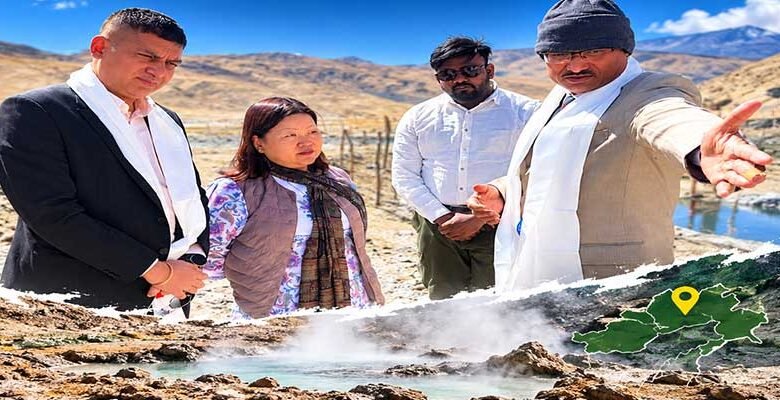
ITANAGAR- Arunachal Pradesh is exploring the potential of geothermal energy as a clean and locally generated source of power, particularly for remote and strategically located border areas, Science and Technology Minister Dasanglu Pul said on Saturday.
Pul, accompanied by Centre for Earth Sciences and Himalayan Studies (CESHS) Director Tana Tage and departmental geologists, visited the ONGC Geothermal Project at Puga Valley in Ladakh to study geothermal exploration, drilling and clean-energy generation in high-altitude Himalayan conditions.

The visit comes as Arunachal Pradesh examines its own geothermal resources, particularly in the Mago-Thingbu belt of Tawang district, where the state has estimated potential of around 10–15 MW, according to the information provided by the department.
The Puga visit has significance for Arunachal because ONGC has moved its Ladakh geothermal programme into an advanced exploration stage. ONGC says Puga and Chumathang are among India’s most promising geothermal fields and describes geothermal energy as a continuous renewable source that is not dependent on day-night or seasonal variations.
Also Read- SIFF Asks Arunachal CM for More Time Before SUMP Talks
In July 2026, ONGC commissioned two geothermal wells at Puga Valley, at an altitude of more than 14,000 feet. The two wells, each reaching about 1,000 metres, are intended to support reservoir evaluation and pave the way for a proposed 1-MW demonstration geothermal power project.
Arunachal’s geothermal prospects
Scientific investigations into Arunachal’s geothermal resources have been undertaken for several years. The Mago-Thingbu area in Tawang has emerged as one of the locations being examined for possible applications of geothermal heat.
In March 2024, CESHS, along with the Norwegian Geotechnical Institute and Iceland-based Geotropy, conducted field investigations and geological structural mapping around hot-spring locations including Mago and Thingbu.
The investigations are intended to establish a better understanding of the state’s geothermal resources and their possible applications.
Also Read- Vehicles Set Ablaze, MLA Alo Libang’s Residence Gheraoed Amid SUMP Protest
Potential uses extend beyond electricity generation. The studies are also looking at possibilities such as heating and cooling, agricultural produce drying and other locally appropriate applications.
CESHS and Oil India Limited subsequently moved towards pre-feasibility studies involving surface and subsurface investigations at Mago, Thingbu, Damteng and Tsechu in Tawang district.
Field investigations have also been conducted at five geothermal locations in Tawang—Damteng, Grengkhar, Mago, Thingbu and Tsechu—with samples collected for geochemical analysis.
Lessons from Puga
For Arunachal, the Ladakh visit provides an opportunity to examine how geothermal resources can be assessed and developed under difficult Himalayan terrain.
Pul said the experience gained from the Puga project could strengthen Arunachal’s own efforts to explore geothermal energy, particularly in remote and border areas where conventional power infrastructure can be challenging.
The minister said the state wanted to harness its natural resources responsibly and use them to support a sustainable energy future.
Also Read- ‘No PFR, No Survey’: Protests Intensify Over Proposed Siang Mega Project
“Arunachal Pradesh is blessed with immense natural resources, and our endeavour is to harness this potential responsibly for a sustainable future,” Pul said.
She also appreciated ONGC and its execution partner SEROS for sharing technical expertise and field experience during the visit.
Why geothermal energy is being examined
Unlike solar and wind generation, geothermal energy can potentially provide power continuously because it draws on heat beneath the Earth’s surface. ONGC describes it as a renewable source available around the clock and not dependent on sunlight or seasonal wind conditions.
India has also moved towards a broader policy framework for geothermal energy. The National Policy on Geothermal Energy, notified in September 2025, provides a framework for exploration and development of geothermal resources, with the Ministry of New and Renewable Energy as the nodal ministry.
The development of Arunachal’s geothermal sector, however, remains at the exploration and assessment stage. The 10–15 MW figure cited for the Mago-Thingbu belt represents estimated potential, rather than an operational or commissioned generating capacity.
For Arunachal Pradesh, further geological, geochemical and subsurface investigations will therefore be important in determining whether identified geothermal resources can be developed commercially or for local direct-heat applications.
If the resources prove technically and economically viable, geothermal energy could eventually add another source to Arunachal’s clean-energy mix, alongside its existing renewable-energy resources.