UPI MDR From October 15: 0.4% Charge on Specified P2M Payments Above ₹2,000
New MDR will be paid by merchants, with a ₹300 cap on standard payments of ₹75,000 and above; P2P transfers and low-value payments remain free.
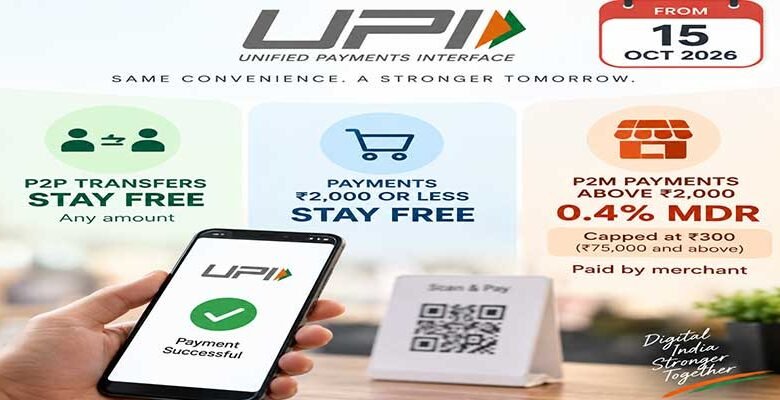
NEW DELHI- A new merchant discount rate (MDR) structure for specified person-to-merchant (P2M) UPI transactions is set to take effect from October 15, 2026, ending the zero-MDR regime that has covered most P2M UPI payments since around 2020.
Under the new structure, specified P2M transactions above ₹2,000 will attract an MDR of 0.4%, with the charge capped at ₹300 for payments of ₹75,000 and above. The MDR will be borne by the merchant rather than the customer.

Importantly, person-to-person (P2P) UPI transfers will remain free, while P2M payments of ₹2,000 or less will also remain free. Small merchants classified under the P2PM category—those receiving up to ₹1 lakh a month through UPI QR—will remain exempt even when an individual transaction exceeds ₹2,000.
According to the figures cited in the policy discussion, transactions above ₹2,000 represent only around 4–5% of P2M transaction volume, but account for approximately 65–67% of transaction value. Consequently, more than 95% of P2M transaction volume is expected to remain unaffected.
Also Read- Tai Tagak Extends Support to Proposed UWATCH During RIWATCH Visit
How the new charges will work
For standard P2M transactions above ₹2,000, the MDR will be 0.4%. A ₹3,000 payment, for example, would attract ₹12 in MDR, while a ₹10,000 payment would attract ₹40.
The MDR will be capped at ₹300 for payments of ₹75,000 and above. Thus, a ₹1 lakh payment would attract ₹300 rather than ₹400.
Certain categories will have separate rates. Essential and public-service categories, including railways, telecom, insurance, fuel, utilities such as electricity and water, agricultural inputs and education in many accounts, will attract a flat ₹5 charge above ₹2,000.
For capital-market-related payments, including mutual funds, securities and broker payments, the rate will be 0.02%, also subject to a ₹300 cap.
GST at 18% will apply to the MDR amount, rather than to the underlying transaction value.
The structure also bars UPI apps from imposing platform fees, while banks and aggregators have been instructed not to pass the MDR on to customers.
Also Read- Tai Tagak Extends Support to Proposed UWATCH During RIWATCH Visit
Government rationale and merchant concerns
The new system has been presented as a measure to improve the financial sustainability of the UPI ecosystem, allowing banks, payment service providers and apps to invest in infrastructure, cybersecurity and expansion of acceptance without depending indefinitely on government subsidies.
Expected collections have been cited at around ₹15,000 crore, with a portion intended to support small-merchant acceptance.
The government has maintained that the MDR is not a tax and that customers will not be charged for UPI payments. It has also said that the system will be monitored daily from October 15 to discourage merchants from shifting customers towards cash.
Existing QR codes and soundboxes will continue to function. However, merchants in the P2PM category can be moved into the regular P2M category if their UPI QR receipts exceed ₹1 lakh per month for three consecutive months.
Also Read- IGTAMSU NSS Volunteers Complete Seven-Day Special Camp at Hong Village
Trader groups raise concerns
The proposed changes have prompted concerns among several trader and retail organisations, particularly over the impact on small and medium-sized businesses.
The Retailers Association of India (RAI) has argued that the ₹1 lakh monthly P2PM threshold could be too low for some micro enterprises and warned that merchants could reconsider UPI in favour of cash, particularly during the festive season when individual purchases can exceed ₹2,000.
The Clothing Manufacturers Association of India (CMAI) has also raised concerns about additional cost pressure on MSME retailers during a period of increased festive demand.
Some local market associations and trader groups have discussed promoting cash payments, citing existing business costs and thin profit margins. Some fuel dealers have also discussed refusing UPI payments above ₹2,000.
CAIT Odisha has opposed the MDR and the GST applicable to it and has discussed seeking relief from the Finance Ministry. The organisation has also considered a possible UPI boycott if its concerns are not addressed.
At the same time, ASSOCHAM has welcomed the calibrated structure, arguing that a sustainable revenue model is necessary for continued investment in digital-payment infrastructure and technology, while noting that the overwhelming majority of merchant transactions would remain unaffected.
The Swadeshi Jagran Manch, however, has criticised the move and called for reconsideration, arguing that UPI should continue to be treated as a public digital utility.
Political dispute over the policy
The new MDR structure has also become a subject of political debate.
Leader of Opposition Rahul Gandhi has described the proposed levy as a “UPI tax” and called for its rollback, arguing that merchants could ultimately pass the cost to consumers through higher prices. Congress president Mallikarjun Kharge and other opposition leaders have also demanded that the decision be withdrawn.
The government has rejected the rollback demand and denied that the policy was influenced by foreign pressure. It has maintained that the decision is aimed at building a sustainable and inclusive UPI ecosystem and reiterated that customers will not bear the MDR directly.
BJP sources have pointed to an August 2026 Parliamentary Standing Committee on Finance report, which recommended a calibrated, tiered revenue model for UPI and called for prompt notification. The committee included MPs from different parties, including Congress members.
PhonePe CEO Sameer Nigam has also supported the need for a viable revenue model for the industry, while stating that approximately 96% of receiving users would remain exempt.
What remains unchanged
For ordinary users, the central features of UPI remain unchanged: P2P transfers remain free and payments of ₹2,000 or less remain free. Small merchants within the specified P2PM threshold will also remain exempt.
The principal change concerns specified higher-value P2M payments, where the cost shifts from the previous zero-MDR model to a merchant-paid MDR structure.
The policy debate is now focused on whether the ₹2,000 transaction threshold and ₹1 lakh monthly P2PM limit will remain unchanged, and whether merchant resistance could lead to greater use of cash.
The government has so far maintained that there will be no rollback, that consumers will not be charged directly, and that daily monitoring will begin with implementation of the new structure on October 15.