NDRF Conducts Two-Week Disaster Preparedness Exercise Across Shi-Yomi
The two-week familiarization exercise focused on school safety, community awareness, mock drills and practical rescue techniques to reduce response time during disasters.
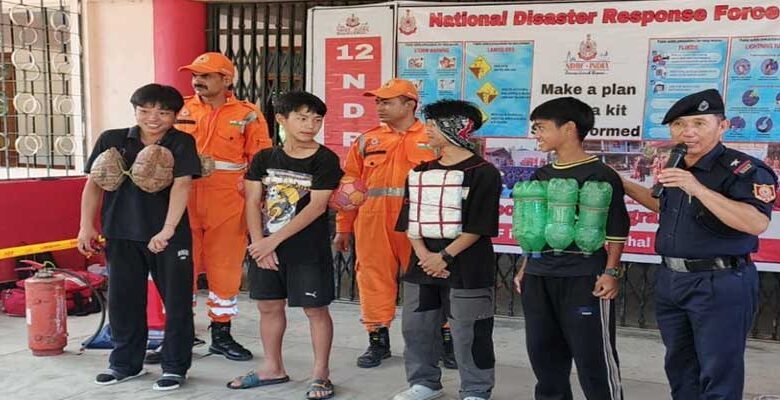
SHI YOMI – A two-week disaster preparedness and community awareness exercise conducted by the 12th Battalion of the National Disaster Response Force (NDRF), Itanagar, has covered the remote border subdivisions of Tato, Mechukha and IMonigong in Shi-Yomi district.
The familiarization exercise, held from August 2 to August 16, 2026, focused on strengthening the disaster response capabilities of local communities and institutions through practical training, school safety programmes and mock drills. The programme was coordinated by Vijay Mitte, DDMO, Shi-Yomi District Disaster Management Authority, under the guidance of Deputy Commissioner Manjunath R.

The most significant aspect of the exercise was its focus on remote and border areas, where reducing the response time of first responders can be critical during emergencies. The NDRF team visited all three border administrative headquarters of the district and conducted disaster awareness programmes involving schools, villages, government establishments and other local stakeholders.
Also Read- Himalayan University Holds Anti-Ragging Awareness Programme
The programme targeted a wide range of participants, including Gaon Buras, NGOs, NCC, Scouts and Guides, teachers, students and government officials, with the objective of building wider community-level preparedness rather than limiting disaster response knowledge to specialised agencies.
At Mechukha, ADC Tana Yaho (APCS) urged students, teachers, officers and others attending the programme to learn and share the life-saving techniques and basic survival skills demonstrated by the NDRF team.
During the programme at Monigong, ADC Idam Bagra (APCS) interacted with the NDRF team and appreciated the conduct of the disaster management programme in the remote subdivision. He noted its potential importance in preventing loss of life by helping reduce the response time of first responders.
Also Read- Mushroom Cultivation Training Held at Aalo to Promote Rural Livelihoods
The exercise began with a School Safety Programme at Vivekananda Kendra Vidyalaya, Tato, focusing on disaster preparedness, mitigation and safety measures to be followed before and during natural disasters.
The NDRF team provided extensive practical demonstrations during the two-week exercise. These included improvised rescue methods using locally available materials such as bamboo, plastic bottles, sandbags, blankets and school uniforms.
Participants were also trained in techniques for moving injured or trapped persons, including one-man trench, two-men trench and piggyback carrying methods. Basic survival tactics were demonstrated to help participants respond more effectively during emergencies.
Also Read- Three-Day Capacity Building Programme for Primary Teachers Begins in Tawang
Emergency medical response was another key component. The team conducted demonstrations and drills covering CPR, basic emergency medical first response and trauma care, giving participants practical exposure to immediate actions that can be taken before specialised assistance arrives.
The exercise also included demonstrations on searching for and rescuing victims trapped inside collapsed structures. Participants were shown how to prepare improvised harnesses and stretchers using ropes and fastening knots, further emphasising the use of locally available resources during emergencies.
The programme addressed disaster risks particularly relevant to the district, including earthquakes, flash floods, landslides and mudslides, along with fire safety. Participants were briefed on the appropriate dos and don’ts for responding to such emergencies.
The exercise underlines the importance of community-based disaster preparedness in remote areas of Arunachal Pradesh, where difficult terrain and distance can make rapid access by specialised response teams challenging. By training local stakeholders in basic rescue, medical response and survival techniques, the programme aims to strengthen the first line of response and potentially minimise casualties during emergencies.