Arunachal Unveils Vision to Become ‘Land for Hornbills by 2047’
Government agencies, Indigenous communities, scientists and conservation groups have jointly drafted a roadmap to protect hornbills and their habitats across Arunachal Pradesh.
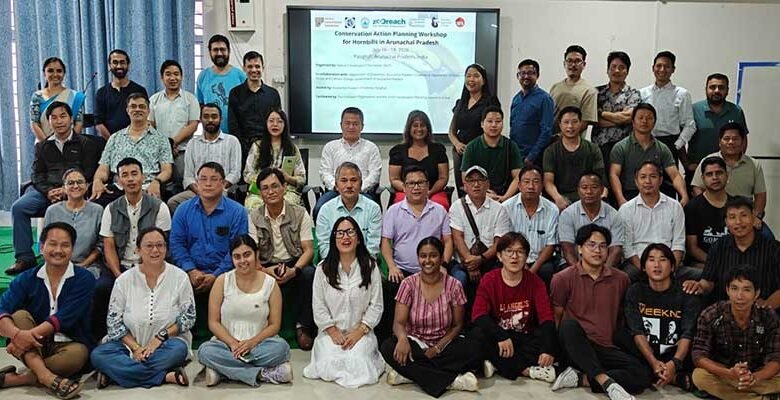
PASIGHAT- Arunachal Pradesh has taken a major step towards wildlife conservation by adopting a vision to become a “Land for Hornbills by 2047”, with stakeholders from across sectors jointly developing a framework for a State-wide Hornbill Conservation Action Plan.
The initiative emerged from a three-day multi-stakeholder workshop held from July 16 to 18 at Arunachal Pradesh University, Pasighat, bringing together more than 55 representatives from government departments, Indigenous communities, universities, research institutions, conservation organisations and civil society.

Participants agreed on the need for a coordinated, landscape-level approach to conserve hornbills and their habitats while strengthening community-led conservation initiatives and integrating traditional ecological knowledge with scientific research.
Also Read- CJP Says Pradhan’s Removal Is ‘Non-Negotiable’
Arunachal Pradesh is home to five of India’s nine hornbill species—the Great Hornbill, Wreathed Hornbill, Rufous-necked Hornbill, Austen’s Brown Hornbill and Oriental Pied Hornbill. Three of these species are globally threatened, while all five receive the highest level of legal protection under the Wildlife (Protection) Act.
The Great Hornbill, which is the State Bird of Arunachal Pradesh, holds significant cultural importance among many Indigenous communities and plays a vital ecological role in dispersing seeds and regenerating forests.
Despite nearly 80 per cent forest cover, participants observed that hornbill populations outside protected areas continue to face challenges from habitat degradation, fragmentation and hunting. The proposed conservation strategy therefore focuses on supporting Indigenous communities in protecting forests, improving habitat connectivity and fostering long-term partnerships across Arunachal Pradesh and neighbouring transboundary landscapes.
Also Read- DC Orders Action Against Contractors Over Delayed Projects in Tawang
The workshop was organised by the Nature Conservation Foundation (NCF) in collaboration with the Department of Economics, Arunachal Pradesh University, the Department of Environment, Forests and Climate Change, Government of Arunachal Pradesh, and the Zoo Outreach Organization.
Representatives from the Arunachal Pradesh Forest Department, Arunachal Pradesh State Biodiversity Board, Rajiv Gandhi University, the Indian Institute of Science, Wildlife Trust of India (WTI), Ashoka Trust for Research in Ecology and the Environment (ATREE), WWF-supported community conservation groups, the Nagaland Forest Department, Nagaland Community-Conserved Areas Forum, Aaranyak and several community organisations participated in the deliberations.
Following presentations and group discussions, participants prepared a shared vision and an initial action framework. A drafting committee will now refine the document, with the first draft expected by September and the final Hornbill Conservation Action Plan scheduled for completion early next year.
Also Read- APSLSA Concludes Second 40-Hour Mediation Training Programme in Arunachal
Speaking after the workshop, Dr. Aparajita Datta, Executive Director and Senior Scientist at the Nature Conservation Foundation and Co-Chair of the IUCN SSC Hornbill Specialist Group, said the collaborative conservation plan would strengthen community-led initiatives and help realise the vision of making Arunachal Pradesh a true “Land for Hornbills.”
Officials and experts participating in the workshop emphasised that the action plan would not only help conserve hornbills but also protect forests, preserve Indigenous knowledge systems and promote sustainable livelihoods linked to biodiversity conservation.