“India Is Strong, Watch Dhurandhar”: Arunachal Minister Balo Raja Hits Back at ITBP Chief’s Border Remarks
The minister’s remarks follow ITBP Director General Shatrujeet Singh Kapoor’s comments about continuing face-offs with Chinese troops at multiple locations along the Arunachal Pradesh frontier, prompting renewed political debate over border security and transparency.
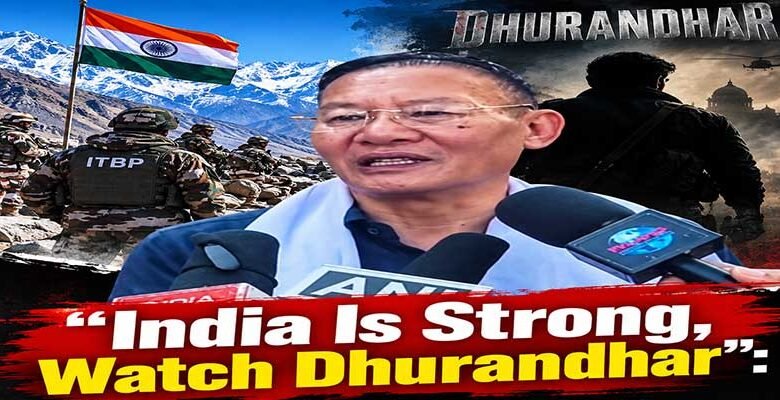
Speaking to reporters in Itanagar on Tuesday, Raja questioned why a senior border security official would make statements that could create an impression of weakness. Referring to the film, he pointed to what he described as India’s growing intelligence capabilities.
“Why make statements like that when you are a DG? Why perceive yourself as weak? India is very strong. You must have seen the Dhurandhar movie; watch it, and you will see how much India’s intelligence capabilities have grown,” Raja said, according to a video of his remarks reported by ANI.

What did the ITBP chief say?
The minister’s comments came after ITBP chief Shatrujeet Singh Kapoor spoke about ongoing encounters and face-offs involving Indian and Chinese personnel at multiple locations along the Line of Actual Control (LAC) in Arunachal Pradesh.
Addressing personnel at an ITBP base in Alwar, Rajasthan, on October 22, Kapoor highlighted the changing nature of warfare and the challenges of matching China’s military capabilities through traditional methods alone.
He reportedly said that competing with China using conventional methods would be difficult and emphasised the growing importance of drones, counter-drone systems and specialised combat capabilities.
Kapoor also said that the ITBP’s newly raised Shaurya commandos had demonstrated their capabilities during face-offs with Chinese People’s Liberation Army (PLA) personnel at multiple locations along the frontier. The force plans to deploy these commandos across its border battalions as part of efforts to strengthen operational preparedness.
Also Read- Siang Par Sangram: Understanding the Controversy Around the Proposed Dam
MEA responds to the border situation
The remarks have drawn political attention to the situation along the India-China border, particularly concerning reports of continuing face-offs in Arunachal Pradesh.
On October 23, Ministry of External Affairs spokesperson Randhir Jaiswal said that conditions in India-China border areas occasionally deteriorate when Chinese forces deviate from established patrolling protocols.
The MEA maintained that both countries continue to use existing diplomatic and military mechanisms to address outstanding issues and prevent misunderstandings or miscalculations along the LAC. It also reiterated that peace and tranquillity in the border areas are essential for the broader development of bilateral relations.
Also Read- Upper Subansiri Bandh: Arson, Vandalism Reported Amid Anti-Dam Protests
Political debate over transparency and national security
The border remarks have also prompted questions from opposition leaders. AIMIM president Asaduddin Owaisi has sought a detailed explanation from the Centre regarding reports of Chinese intrusions, restrictions on Indian patrols and the broader situation along the frontier.
Owaisi has called for greater transparency and accountability, arguing that Parliament and the public should be informed about developments affecting India’s territorial integrity and national security. These are political demands and allegations; the specific operational details have not been established by the cited reports.
Also Read- SUMP Protests: East Siang Officials Call for Peace, Warn of Legal Action
A debate beyond political rhetoric
Raja’s statement places emphasis on national confidence and India’s intelligence capabilities, while Kapoor’s reported comments focus on the operational challenges posed by China’s military modernisation and the need to adapt to emerging forms of warfare.
The reference to Dhurandhar served as a rhetorical example in the minister’s argument; a fictional film does not independently establish the effectiveness of India’s intelligence operations or resolve questions about the border situation.
The wider issue remains the security environment along the LAC, where India and China continue to rely on military and diplomatic channels to manage tensions. Assessing the situation requires clear information about developments on the ground, the preparedness of security forces and the status of established border-management mechanisms.
For now, Raja’s remarks underline the political sensitivity surrounding border security in Arunachal Pradesh, while the ITBP chief’s comments have brought renewed attention to military preparedness and the evolving nature of India-China competition.