Dasanglu Pul Calls for Better Delivery of Welfare Schemes to Remote Areas
Women and Child Development Minister Dasanglu Pul urges officials and frontline workers to improve implementation, monitoring and accountability under Mission Shakti, Mission Vatsalya and POSHAN 2.0 to ensure welfare benefits reach women and children in remote areas.

ITANAGAR – Arunachal Pradesh Women and Child Development Minister Dasanglu Pul has called for stronger implementation and monitoring of welfare schemes to ensure that women and children in the state’s remotest areas receive essential services and benefits.
Addressing the concluding session of the State Poshan Award 2026-cum-Review Meeting at the D K Convention Centre in Itanagar on Thursday, Pul urged departmental officials and frontline workers to carry out their responsibilities with greater dedication and accountability.

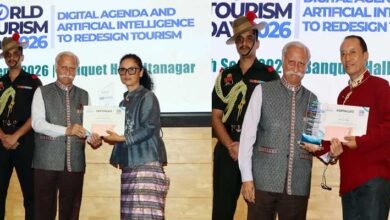
She congratulated the award recipients for their contributions to delivering services at the grassroots level and emphasised the need to translate the government’s welfare priorities into effective implementation.
The programme was organised by the Women and Child Development Department as part of its two-day Chintan Shivir, which reviewed the implementation of major centrally sponsored schemes, including Mission Vatsalya, Mission Shakti and Saksham Anganwadi and POSHAN 2.0.
Also Read- Jiden Gao Wins Institutional-Level Youth Debate Competition at Arunachal Pradesh University
Focus on nutrition, child protection and women’s welfare
The review meeting examined several areas of service delivery, including nutrition interventions, early childhood care and education, child protection, maternity benefits and support for women facing violence or distress.
Commissioner Mimum Tayeng welcomed the participants and stressed the importance of coordination among departmental officials to improve the delivery of welfare services.
The discussions brought together officials responsible for different schemes to review implementation challenges and identify ways to strengthen field-level operations.
The emphasis on reaching remote communities is particularly significant for a geographically dispersed state such as Arunachal Pradesh, where effective service delivery depends on coordination between administrative authorities, Anganwadi centres and frontline workers.
Also Read- Arunachal’s Hydropower Push: ₹52,000 Crore Investment Pipeline for Five New Projects
Poshan Tracker training to improve digital monitoring
A key component of the Chintan Shivir was a training session on the latest features of the Poshan Tracker application, conducted by Sunamoni Kar, State Coordinator of the National e-Governance Division (NeGD).
The session covered digital monitoring of home visits, tracking children’s developmental milestones, geotagging Anganwadi Centres and verifying beneficiaries.
These digital tools are intended to improve the monitoring of nutrition and early childhood services, maintain beneficiary records and help officials assess whether services are reaching intended recipients.
However, the effectiveness of digital monitoring will depend on accurate data entry, regular field-level updates and the ability of officials to address gaps identified through the system.
Deputy Director Machi Gao stressed the importance of regular field visits and effective supervision to improve the functioning of Anganwadi services.
Also Read- First-Ever Keyi Panyor Bird Count Records 38 Species in Two Hours
Review of child protection and women’s support programmes
Mission Vatsalya State Nodal Officer Kina Takka highlighted child protection mechanisms, rehabilitation and family-based care.
Gyati Loder presented initiatives under Saksham Anganwadi and POSHAN 2.0, which focus on nutrition and related services.
Mission Shakti State Nodal Officer Bahi Koyu discussed the Pradhan Mantri Matru Vandana Yojana, the SHe-Box portal and One Stop Centres.
The sessions covered programmes intended to support maternal welfare, address workplace-related complaints of sexual harassment and provide assistance to women facing violence or distress.
The review provided an opportunity to discuss coordination among the programmes and the importance of making support services accessible to eligible beneficiaries.
Grassroots workers and officials recognised
The department recognised the contributions of Child Development Project Officers (CDPOs), supervisors and directorate staff involved in implementing welfare programmes.
Commendation certificates were presented to officials and staff associated with several Integrated Child Development Services (ICDS) projects, including Dirang, Mukto-Bongkhar, Kitpi, Aalo-West, Jang-Thingbu, Bomdila, Roing, Lumla-Zemithang, Namsai, Bordumsa-Diyun and Lekang.
Recipients of the State Poshan Award and Anganwadi workers also shared their experiences of implementing nutrition and early childhood care initiatives at the community level.
Their participation highlighted the role of frontline workers in delivering services, identifying beneficiaries and connecting families with government programmes.
Accountability identified as key to better service delivery
The two-day Chintan Shivir concluded with a renewed emphasis on coordination, accountability and monitoring across the department.
The discussions highlighted the need to combine digital tracking with regular field visits, effective supervision and coordination among officials to improve welfare outcomes.
While the review covered several major schemes, the long-term impact will depend on how effectively the recommendations are implemented and whether improvements translate into more accessible and reliable services for women and children, particularly in remote communities.
Department Director Chadan Tangjang proposed the vote of thanks, bringing the programme to a close.