SUMP Project | PFR First, No Rush to Proceed Beyond Feasibility: CM Pema Khandu
Speaking at Boleng, Pema Khandu said the immediate priority is completion of the Preliminary Feasibility Report, after which the project's technical viability and next steps will be assessed.
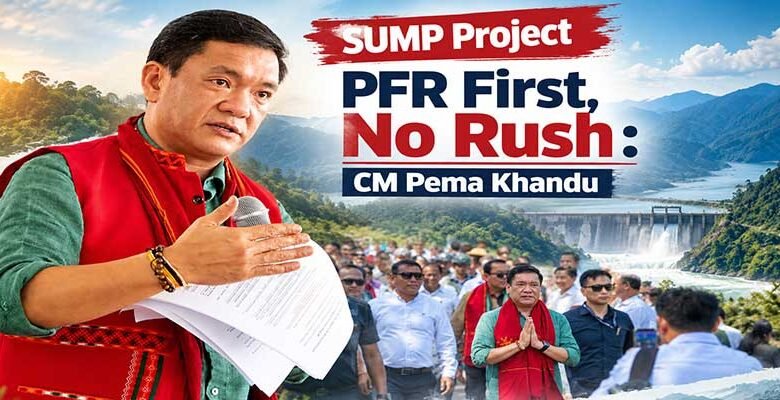
BOLENG- Arunachal Pradesh Chief Minister Pema Khandu has said the government is not seeking to rush the proposed Siang Upper Multi-Purpose Project (SUMP) beyond the feasibility stage and that the immediate priority is to complete its Preliminary Feasibility Report (PFR).
Addressing an interaction programme with government officers and officials of Siang district at Boleng, Khandu said the PFR would provide the technical clarity needed to determine whether, where and how the proposed project could be developed.

“If the experts determine after the PFR that the project cannot be built, there will be no further process,” he said.
The Chief Minister said the PFR is expected to take about three months, covering November, December and January. According to him, the exercise would examine critical technical parameters, including the feasibility of constructing the proposed structure in Seismic Zone V, possible protection against a release of water from upstream and the availability of technically suitable locations.
Also Read- Assam Rifles Jawan Killed, Four Injured in Suspected Militant Attack in Changlang
Further studies only if project is found feasible
Khandu said that if the PFR establishes the technical feasibility of the project, subsequent processes would include Social Impact Assessment (SIA), Environment Impact Assessment (EIA) and preparation of a Detailed Project Report (DPR) in accordance with applicable laws and procedures.
The Chief Minister also stressed that the project should be examined through scientific and technical assessments rather than being accepted or rejected without adequate information.
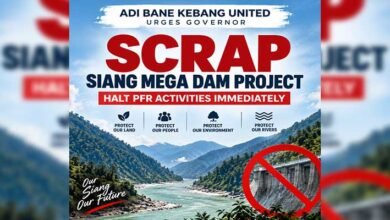
His comments come amid continuing public debate and opposition in parts of the Siang region over the proposed project. Recent reports have documented protests and tensions linked to PFR-related activities, while the government has maintained that the current exercise is intended to establish feasibility rather than authorise construction.
National security dimension
Khandu said SUMP should not be viewed only as a conventional hydropower project, describing it instead as a project with wider national and strategic implications.
He referred to the large water infrastructure project announced by China in 2021 and said India and Bangladesh had sought information and discussions from the Chinese side concerning the project and water-related concerns, but those requests had not been accepted.
The Chief Minister also referred to existing water-diversion infrastructure in China and proposals involving diversion of water towards its northern dry belt.
Against this backdrop, he said the proposed SUMP should be assessed on the basis of scientific and technical evidence.
The project has previously been described by the government as being of national importance, while official preparations for its PFR have involved coordination among state departments and security agencies.
Also Read- 30 CJP Volunteers including Ashutosh Ranka Detained in Guwahati Ahead of Regional Meeting
Assurance of consultation with affected communities
Khandu assured that if the project moves beyond the feasibility stage, the government would undertake extensive consultations with affected communities.
He said that once a technically feasible location is identified, the government would engage with Gram Panchayats, villages and local communities, make detailed presentations and discuss the project point by point.
He also distinguished between land acquisition, assessment of agricultural and horticultural assets, and Relief and Rehabilitation (R&R).
According to the Chief Minister, people whose land is acquired would receive compensation under applicable rules, while affected villages would be consulted on relocation, including the choice of location. He also referred to the need for basic infrastructure such as roads, schools, electricity and water in relocated settlements.
Khandu further said that public hearings and consultations would form part of the subsequent process and indicated that if these processes establish that the project should not proceed, the prescribed process would provide an opportunity for that outcome.
CM offers direct engagement with villagers
Emphasising the need for direct communication, Khandu said he would undertake an extensive tour of the Siang region during his next visit.
He said he was prepared to spend a week or even 10 days in the area, visiting villages suggested by local officers and community representatives and listening directly to residents’ concerns and questions.
“My duty is to tell you everything. My duty is to listen to your questions. It is our responsibility,” he said.
Investment and employment potential
Khandu also highlighted the possible economic implications of the project, estimating that the investment could initially be around ₹1.5 lakh crore and potentially rise to ₹2 lakh crore.
He said such an investment could generate economic activity and employment opportunities for local youth in areas including construction, road building, quarrying, supply of aggregates and sand, transportation and other ancillary activities.
At the same time, the Chief Minister urged government officers to develop a comprehensive understanding of the project and facilitate informed public discussion.
He said accurate information and technical clarity would be important to prevent misinformation and uncertainty from dominating the debate surrounding SUMP.
The government’s present position, as outlined by Khandu, therefore places the PFR as the immediate decision point: the project would move to subsequent assessments only if the feasibility exercise establishes that it can technically be developed.