Fresh Siang Dam Tension: Komkar Villagers Block CAPF, Police Entry to Ugeng Site
The latest blockade comes months after hundreds of Komkar residents formally backed PFR activities, highlighting a growing dispute over the project, community consent and representation.
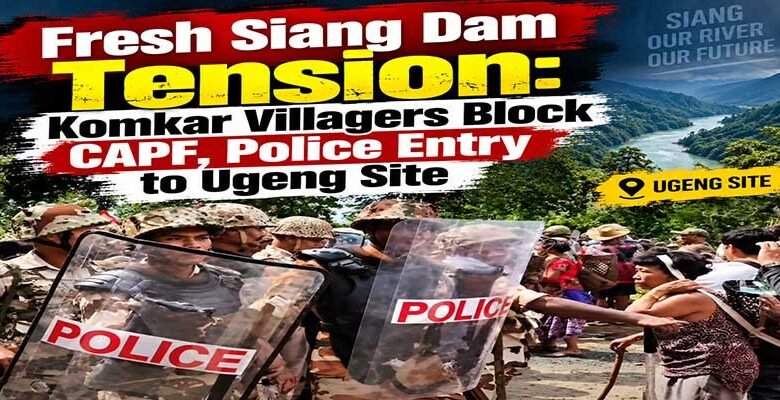
YINGKIONG- Tension over the proposed Siang Upper Multipurpose Project (SUMP) resurfaced on Monday after residents of Komkar and Riga villages stopped Central Armed Police Force (CAPF) and police personnel from entering the Ugeng site, where activities related to preparation of the project’s Pre-Feasibility Report (PFR) are reportedly underway.
The latest confrontation assumes significance because Komkar had earlier emerged as one of the strongest centres of local support for the PFR process. In December 2025, representatives of 245 out of 257 households of Komkar signed a memorandum of understanding with the Arunachal Pradesh government supporting PFR-related studies. (Arunachal24)

The support subsequently increased. In March 2026, another 56 residents submitted their consent, taking the reported number of consenting households to 297 out of 302. A further 39 residents later extended their support, taking the total number of supporters reported from Komkar to 336. (Arunachal24)
The latest confrontation therefore presents a significant change in the situation on the ground—or, at the very least, demonstrates that support for the PFR process does not represent a settled or uncontested position within the wider community.
Villagers stop security personnel at Ugeng
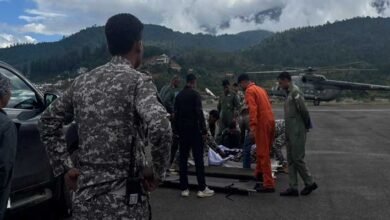
According to reports from the area, CAPF personnel were deployed overnight at Riga village amid continuing tension over the proposed project. When security personnel attempted to proceed towards the Ugeng site on Monday, villagers reportedly stopped them and reinforced a blockade.
The development follows an earlier incident in September when local residents reportedly intercepted PFR-related equipment, including JCB machines, being transported towards the Ugeng site. The machinery was subsequently moved elsewhere.
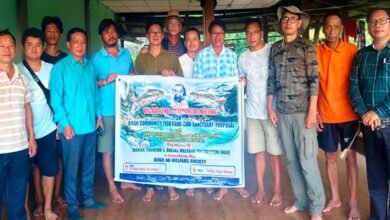
Villagers later erected a bamboo barricade and a stone wall along the road leading to the proposed PFR site, according to a report published on Monday. Protesters from Pangkang, Sitak, Riew and Begging also reportedly joined the demonstration at Ugeng.
The protesters have maintained that directly affected communities have not consented to the proposed dam and have demanded that project-related activities should not proceed without consultation and dialogue with affected communities.
Why the latest development is significant
The present situation is particularly important because of Komkar’s earlier documented support for the PFR process.
Your earlier reports recorded that 245 households initially supported the PFR, followed by another 56, taking the reported figure to 297 out of 302 households. A subsequent report recorded another 39 supporters, taking the total number of supporting residents to 336. (Arunachal24)
The December 2025 agreement was specifically related to preparation of the PFR, rather than approval for construction of the proposed dam. The state government had also said that no construction decision would be taken without further consultation and consent of project-affected families.
This distinction is important. A PFR is part of the preliminary assessment process and does not itself amount to final approval for construction of the project.
However, the latest resistance suggests that the question of whether the PFR can proceed, and who has the authority to give community consent, remains contested.
A parallel dispute over Komkar’s consent
There has also been a separate development concerning the December 2025 MoU.
A report published in March 2026 said the Komkar Baane Kebang, the traditional village council, had adopted a resolution questioning the validity of the December MoU and maintaining that it did not represent the collective decision of the village. The reported resolution called for future decisions concerning surveys and project-related activities to be taken only after consultation with the village council and community.
Because that account is based on a local-media report of the alleged village resolution rather than an official government document available for independent verification, the position should be treated as an attributed claim, rather than as an established legal determination concerning the validity of the MoU.
Nevertheless, it provides important context to the present standoff.
It indicates that the issue in Komkar is not simply one of support versus opposition to the SUMP, but also involves a question of how community consent is determined and represented under local customary institutions.
Security deployment has been a recurring flashpoint
The use of security forces to facilitate project-related activities has been a contentious issue in the Siang region for more than a year.
In May 2025, villagers in Siang and Upper Siang districts protested the deployment of armed personnel for SUMP-related PFR activities. The Arunachal Pradesh government had earlier issued directions for deployment of CAPF and state police in several locations, including Geku, Ugeng and Jengging, as well as other project-related areas.
At that time, protesters argued that surveys should not be conducted without the consent of affected communities, while authorities maintained that security deployment was required to facilitate the survey process and maintain law and order. The issue has again intensified this month.
On September 7, the Upper Siang district administration imposed restrictions under Section 163 of the Bharatiya Nagarik Suraksha Sanhita (BNSS) in the Geku area, citing apprehensions of protests and possible law-and-order problems related to PFR activities for the SUMP. The order restricted gatherings of five or more persons and certain other activities.
The administration has now also moved towards dialogue. The Upper Siang Deputy Commissioner directed the Geku-Kumku village headman to convene an all-stakeholder peace meeting on September 17 at Peram Dere amid growing tensions over the project.
SUMP remains at the preliminary study stage
The proposed Siang Upper Multipurpose Project is a major planned infrastructure project on the Siang river, but the immediate activities at the centre of the dispute concern the PFR and survey process.
The project has been discussed in the context of hydropower generation, water management, flood moderation and regional development, while the government has also highlighted strategic and water-security considerations.
Opponents have raised concerns over possible displacement, ecological consequences, seismic risks, loss of agricultural land and impacts on the traditional and cultural relationship of indigenous communities with the Siang river. The proposed project has consequently remained one of Arunachal Pradesh’s most contentious development issues.
A complicated picture of community opinion
The latest events make it important to avoid presenting the position of Komkar as uniformly pro-project or uniformly anti-project.
There is clear documentary evidence of substantial support for PFR activities from Komkar residents, including the December 2025 MoU and subsequent submissions that took the reported number of supporters to 336. (Arunachal24)
At the same time, the current blockade and the reported position of the Komkar Baane Kebang indicate continuing opposition or disagreement within the community over project-related activities and the question of consent.
The latest confrontation therefore raises a broader question for the administration: how can PFR activities proceed while ensuring that competing community positions are properly heard and that consent is established through a process accepted by the affected communities?
For now, the immediate issue remains the movement of security forces and PFR-related equipment towards Ugeng. With the administration already preparing for a stakeholder meeting later this week, the coming days could prove important in determining whether the dispute moves towards dialogue or another confrontation.