UIDAI Urges Digitisation of Birth Records
Senior officials from UIDAI and the Arunachal Pradesh government reviewed Aadhaar enrolment, digitisation of records, and DBT-linked services during the UIDIC meeting in Itanagar.
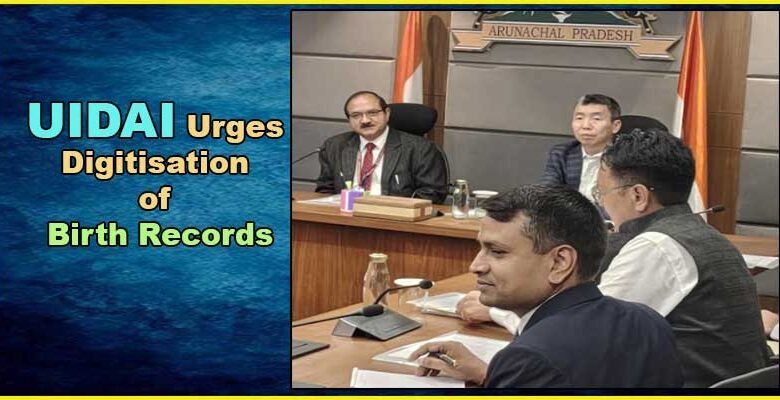
ITANAGAR- The State-Level Unique Identification Implementation Committee (UIDIC) meeting for 2026 was held in Itanagar on March 13 to review the implementation and expansion of Aadhaar services in Arunachal Pradesh.
The meeting was chaired by Kaling Tayeng, Principal Secretary to the Government of Arunachal Pradesh. It was attended by Bhuvnesh Kumar, Chief Executive Officer of the Unique Identification Authority of India (UIDAI), along with senior officials from UIDAI headquarters and its regional office in Guwahati.

Among the senior officials present were Shailendra Singh, Deputy Director General (E&U), and Ngachan Zimik, Deputy Director General of UIDAI Regional Office Guwahati. Secretaries from various state departments, including Economics and Statistics, Health and Family Welfare, and Information Technology and Communication, also attended the meeting.
Also Read- Technology is the biggest enabler: Arunachal Governor
A detailed presentation was delivered by officials from UIDAI Regional Office Guwahati, outlining key aspects of Aadhaar implementation and related initiatives. The presentation was led by Lt. Col. Praveen Chaudhary, Director (Aadhaar Usage) at UIDAI headquarters, and Col. Abhishek Koushik, Director at UIDAI Regional Office Guwahati.
The discussions covered several key issues, including the features and benefits of Aadhaar, the rollout of the new Aadhaar mobile application and the Online Verification and Secure Enrolment (OVSE) registration process.
Officials also reviewed strategies to accelerate Aadhaar enrolment for children aged 0–5 years through the Birth Registration Based Aadhaar Enrolment (BRBAE) system at district hospitals and health facilities using birth registration numbers.
Also Read- Census 2027 Training Held in Palin
Another major focus was improving Aadhaar enrolment coverage in districts with relatively low enrolment rates. The meeting also examined the gap between pending Mandatory Biometric Updates (MBU) and the number of students registered in the UDISE+ portal.
Discussions also addressed the digitisation of birth registration records and the conversion of non-digitised proof of identity (POI) and proof of address (POA) documents issued by the state government.
Participants also deliberated on strengthening Aadhaar seeding and authentication mechanisms for the delivery of state-sponsored schemes through Direct Benefit Transfer (DBT).
Also Read- IMD Forecasts Heavy Rain in Northeast on Mar 14
During the meeting, UIDAI CEO Bhuvnesh Kumar highlighted the growing importance of Aadhaar as a widely accepted proof of identity across multiple sectors in India. He urged the state government to prioritise the enrolment of children into the education system and the UDISE+ portal to address the gap in mandatory biometric updates.
He also emphasised the need to accelerate the digitisation of birth and death registration across all registration units in the state. In order to improve last-mile coverage in remote areas, he suggested exploring the use of resources available through Panchayati Raj Institutions and Common Service Centres.
Kumar also appreciated the efforts of the state government in digitising a large number of proof-of-identity and proof-of-address documents issued by state departments and encouraged the completion of digitisation of remaining legacy records.
Chairing the meeting, Principal Secretary Kaling Tayeng acknowledged the support provided by UIDAI in strengthening Aadhaar services in the state. He noted that improved network connectivity across district headquarters should help address enrolment challenges in districts with lower Aadhaar coverage.
He directed the state Education Department to intensify efforts to enrol students on the UDISE+ portal and undertake a focused campaign to clear pending Mandatory Biometric Updates.
The Principal Secretary also emphasised the benefits of Aadhaar seeding and authentication in improving the delivery of government schemes through Direct Benefit Transfer and instructed departments to issue necessary gazette notifications under Section 7 of the Aadhaar Act, 2016.
Additionally, he directed the two Aadhaar registrars in the state — the Departments of Economics and Statistics and Elementary Education — to assess the operational condition of Aadhaar enrolment kits under their control.
The meeting also discussed the importance of sharing records of deceased individuals between the state government and UIDAI to improve the accuracy of Aadhaar records and strengthen data management systems.
Officials said the discussions were aimed at strengthening Aadhaar enrolment, improving digital governance, and ensuring more efficient delivery of government services across the state.