Arunachal: Governor Flags New Security Challenges in India’s East
Arunachal Pradesh Governor Lt Gen (Retd) KT Parnaik outlined evolving security challenges in India’s eastern frontier at a seminar at the Defence Service Staff College.
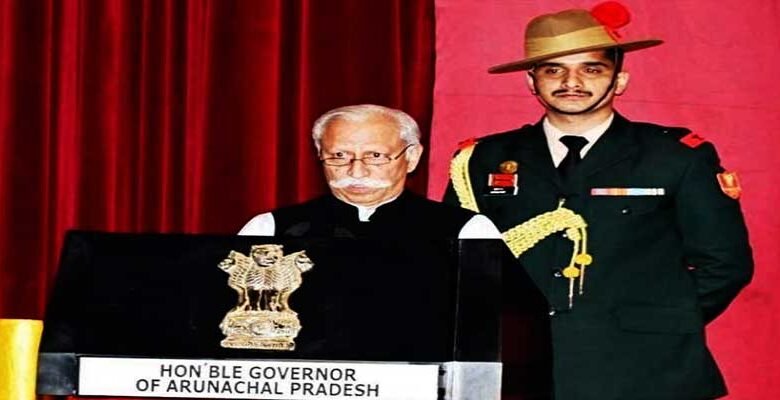
WELLINGTON- The Governor of Arunachal Pradesh, Lt. General K.T. Parnaik (Retd.), on Thursday highlighted the evolving national security challenges confronting India’s eastern frontier, underscoring the impact of instability in neighbouring countries and the need for a coordinated national response.
The Governor was delivering the keynote address at a seminar titled “India’s Eastern Horizons – A New National Security Reality” at the Defence Service Staff College (DSSC), Wellington. The address was part of the 81st Staff Course and was attended by DSSC faculty and around 500 student officers, including 44 international officers from 35 countries.

Speaking on the theme “Arunachal Pradesh and the Emerging North Eastern Security Paradigm,” Parnaik said that India’s North Eastern region occupies a critical position in the country’s strategic landscape and requires sustained development alongside security interventions. He noted that the region’s geography and ethnic diversity have fostered deep cultural and social linkages across international borders, shaping its security dynamics.
Also Read- Seva Aapke Dwar 2.0 Held at Muktur Village
The Governor observed that the North East’s security environment is influenced by a complex interplay of external factors, internal ethno-political realities, local politics, and insurgent movements. These challenges, he said, are interlinked and cannot be addressed in isolation, as they continue to evolve over time.
He traced the roots of the region’s security concerns to historical grievances, trans-national tribal linkages, and porous international borders, all of which add layers of sensitivity and complexity. Addressing these challenges, he stressed, requires a nuanced, inclusive, and people-centric approach that balances security imperatives with dialogue, development, and respect for the region’s social fabric.
Also Read- Mi-17V5 Helicopters Battle Forest Fire in Lohit
Drawing on his extensive experience in the North East and other militancy-affected regions, Parnaik emphasised that lasting peace cannot be achieved through fragmented measures. He called for a Whole-of-the-Nation Approach anchored in a clear strategic vision, seamless political and governance integration, and the strengthening of economic and industrial capacities. He also highlighted the growing importance of technology and the cyber domain, alongside the need to foster societal resilience and robust internal security mechanisms.
The Governor further pointed to the unstable situation in neighbouring Myanmar and Bangladesh, stating that developments in these countries are impacting India in an adversarial manner. He said such challenges must be addressed through coordinated diplomatic, political, and economic efforts.
Also Read- Siang Dialogue 3.0 Focuses on NE and National Security
Highlighting Arunachal Pradesh’s transformation over the past decade, Parnaik noted that the state has emerged as a vital pivot of India’s Act East Policy and the broader vision of Viksit Bharat. He cited significant investments in connectivity, including the construction of over 4,000 kilometres of roads in the last five years, reaching remote and border areas. He added that the expansion of rail and air connectivity has improved integration, governance delivery, and emergency response capabilities.
The Defence Service Staff College, Wellington, is a premier institution that imparts professional military education to selected officers of the Indian Armed Forces and friendly foreign countries, preparing them for higher leadership roles.