Arunachal: Govt Clarifies on Posts, Policing and Tribal Status
Chief Minister and ministers addressed questions on staffing, policing, college infrastructure and tribal classification in the Assembly.
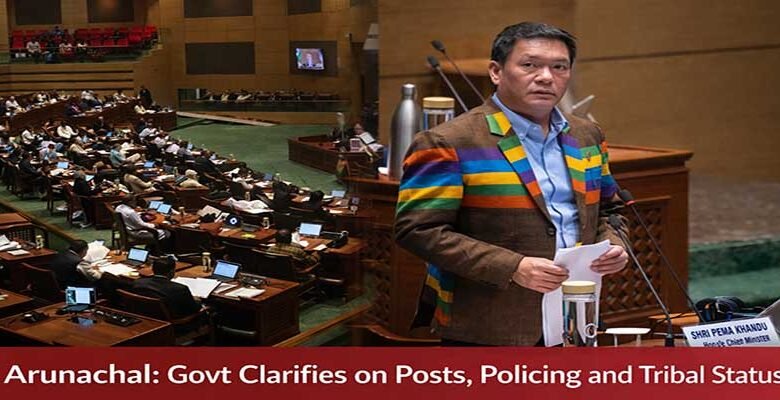
ITANAGAR- Several issues related to administrative staffing, policing infrastructure, education facilities and tribal classification were discussed in the Arunachal Pradesh Legislative Assembly during the ongoing session on Thursday.
Replying to a query by Longding MLA Thangwang Wangham, Chief Minister Pema Khandu informed that the Administrative Reforms Commission (ARC) has submitted an interim report on vacancies and post creation in district administrations.

He said 26 regular and 16 contingency posts were sanctioned when Longding district was created in 2012 and added that Deputy Commissioners have been asked to submit staffing reports for rationalisation of manpower.
Also Read- CM Pema Khandu Outlines State’s Economic Vision in Assembly
Responding to a question by MLA Puinnyo Apum, Home Minister Mama Natung said a police outpost at Paglam was established in 2010 under Dambuk Police Station. He assured that the E-Class outpost will be strengthened with additional manpower.
On infrastructure at Rang-Frah Government College, Changlang, Education Minister P.D. Sona said basic facilities including academic and administrative blocks and hostels have already been provided.
He added that construction of a boundary wall estimated at over ₹40 crore cannot be taken up currently due to funding constraints, though smaller works will be taken up next financial year.
Also Read- Key Development Issues Discussed in Assembly, MLAs Raise Connectivity, School Issues
Responding to a query by MLA Wanglin Lowangdong, SJETA Minister Kento Jini said that while Arunachal is popularly known to have 26 major tribes, the Constitution recognises 23 tribes under the Scheduled Tribes Order, 1950, along with 110 sub-tribes.
He added that the authority to include or exclude communities in the Scheduled Tribes list rests with the President and Parliament, not the state government.