Arunachal Moves to Form Statewide Conservation Forum
A proposed statewide forum aims to unify community-led conservation efforts in Arunachal Pradesh, strengthening policy engagement and biodiversity governance.
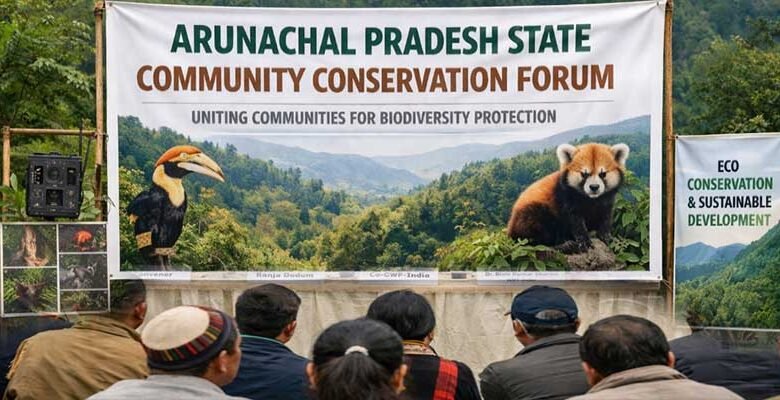
PASIGHAT- Community leaders and conservation practitioners from across Arunachal Pradesh have initiated the formation of the state’s first unified platform for community-led biodiversity protection, signalling a shift towards coordinated grassroots environmental governance.
The decision was taken during a two-day workshop held at Central Agricultural University Pasighat, where participants agreed to establish the proposed Arunachal Pradesh State Community Led Conservation Forum. An interim working group has been constituted to develop the forum’s structure and operational framework over the next six months.

The proposed forum aims to bring together Community Conserved Areas (CCAs) and similar initiatives under a common platform to facilitate advocacy, policy engagement and knowledge-sharing at the state level. Participants noted that such a platform could transform fragmented local efforts into a more cohesive and influential force in shaping biodiversity policy.
Also Read- Chowna Mein Honoured with Brahmaputra Gaurav Samman
Speaking at the workshop, Jibi Pulu, founder of the Elopa Etugu Community Eco-Cultural Preserve, highlighted the significance of collective action. He described the meeting as a first-of-its-kind effort to bring community stakeholders together at a state level, expressing optimism about sustained engagement under the proposed forum.
Dr Rishi Kumar Sharma of WWF-India said the initiative offers an opportunity for communities in Arunachal Pradesh to collaborate not only within the state but also with similar platforms across the region to advance community-led conservation.
Also Read- National Seminar on IKS Concludes at SCCZ
Discussions during the workshop reflected the diversity of ongoing conservation practices. Members of the Elopa Etugu Community Eco-Cultural Preserve shared their experience of using camera traps, which have recorded over 40 wildlife species within their conservation area. Participants also discussed ecological research, biodiversity documentation and livelihood strategies linked to conservation.
Representatives from community conserved areas such as Thembang Bapu highlighted the challenges of balancing ecological protection with economic needs. Measures such as low-cost electric fencing and wildlife monitoring were cited as efforts to mitigate human-wildlife conflict. The impact of commercial agriculture and tourism was also discussed, with emphasis on promoting sustainable and community-based tourism models.
Also Read- RIWATCH Hosts Orientation on Indigenous Languages
Grassroots initiatives from regions such as Tirap were also presented, with conservation leaders noting ongoing awareness campaigns and efforts to expand community participation despite initial challenges.
The 22-member interim working group has been tasked with drafting the forum’s by-laws, governance structure and membership framework. Ranju Dodum and Dimum Pertin have been appointed as convenor and co-convenor respectively.
An advisory panel comprising organisations such as Kalpavriksh, Ashoka Trust for Research in Ecology and the Environment, Nature Conservation Foundation and Green Hub will support the process.
Hranglung Lungalang, chairman of the Nagaland Community Conserved Areas Forum, underscored the urgency of early action, cautioning that ecological degradation can accelerate if conservation measures are delayed.
Participants repeatedly stressed that conservation should be integrated with development rather than positioned in opposition to it. They argued that sustainable development requires aligning infrastructure growth, livelihood opportunities and ecological protection.
As part of the initiative, a digital portal documenting conservation areas, biodiversity records and project profiles is also being planned. Institutions such as Rajiv Gandhi University have expressed support, including hosting future meetings of the interim working group.
Observers noted that if institutionalised effectively, the proposed forum could reshape biodiversity governance in Arunachal Pradesh by providing community-led conservation groups with a unified voice in environmental decision-making.